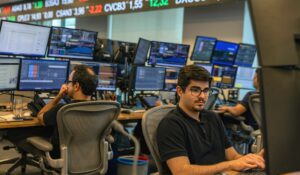

Prediction markets are attracting growing attention from Wall Street, bringing more sophisticated traders, deeper liquidity and greater competition to a sector that has rapidly moved from a niche corner of finance into the mainstream.
For prediction-market platforms, the influx of professional participants can be extremely valuable. More trading creates liquidity, increases transaction activity and can make market prices more accurate.
For individual traders hoping to consistently make money, however, the transformation creates a more difficult environment.
New academic research analyzing $13.76 billion worth of trading activity on Polymarket found that profits were heavily concentrated among a relatively small group of participants.
Approximately 3% of accounts identified by researchers as “persistently skilled” captured around 27% of total profits.
These traders were not simply making better predictions occasionally. According to the research, they repeatedly demonstrated an ability to respond quickly to public information, identify inconsistencies between related contracts and take advantage of behavioral errors made by other market participants.
As more sophisticated traders adopt those strategies, however, the opportunities themselves can begin to disappear.
That is the paradox facing the prediction-market industry: the more efficient these markets become, the more useful they may be as forecasting tools — but the harder they become to beat.
A Small Group of Traders Captured a Large Share of Profits
The working paper offers an unusually detailed look at how profits are distributed across prediction-market participants.
Researchers examined approximately $13.76 billion in Polymarket trades.
Only around 3% of accounts were classified as persistently skilled.
Yet this relatively small group generated approximately 27% of total profits.
The concentration suggests that prediction-market success is not distributed evenly.
Some traders appear capable of repeatedly identifying opportunities that average participants miss.
That pattern resembles what occurs in more established financial markets.
Professional investors spend enormous resources attempting to find small pricing inefficiencies in stocks, bonds, currencies and derivatives.
As markets mature, obvious opportunities are usually identified quickly.
Prediction markets appear to be moving in a similar direction.
What Makes a Prediction-Market Trader Skilled?
The researchers identified several characteristics associated with successful participants.
One was speed.
Skilled traders responded rapidly when new public information became available.
Suppose a prediction contract concerns an election, economic report or sporting event.
When important news arrives, the probability of the outcome may change immediately.
But market prices do not adjust automatically.
Someone needs to trade.
A fast participant can potentially buy or sell contracts before the broader market fully incorporates the new information.
Once enough traders react, however, the price adjusts and the opportunity disappears.
This means speed can become an important competitive advantage.
Related Contracts Can Create Arbitrage Opportunities
Another strategy involves inconsistencies between related markets.
Prediction platforms may list multiple contracts whose outcomes are mathematically or logically connected.
Occasionally, the prices of those contracts may become inconsistent with one another.
A sophisticated trader can identify the mismatch and construct positions designed to profit as prices converge.
This is a form of arbitrage.
In an immature market with limited participation, these inconsistencies may remain available for meaningful periods.
In a highly competitive market filled with professional traders and automated systems, they can disappear within seconds.
That appears to be one of the consequences of Wall Street’s growing interest.
Behavioral Mistakes Create Another Source of Profit
Successful traders also appear to benefit from mistakes made by less sophisticated participants.
Prediction markets combine financial trading with topics that often generate strong emotional reactions.
Politics is an obvious example.
A trader may strongly support a particular candidate and overestimate that candidate’s probability of winning.
Sports can create similar behavior.
Fans may place excessive weight on their favorite teams.
Other participants may react too strongly to headlines or misunderstand how probabilities should be translated into contract prices.
Skilled traders can potentially profit from those behavioral biases.
But as the proportion of sophisticated participants increases, prices may become less influenced by emotional trading.
That reduces another source of potential excess returns.
Skilled Traders Make Prices More Accurate
Yale economist Theis Jensen, a co-author of the research, explained that competition among skilled participants improves market efficiency.
“When many skilled players compete, prices become more accurate,” Jensen said.
This is one of the fundamental mechanisms behind financial markets.
If an asset is obviously underpriced, sophisticated traders buy it.
Their purchases push the price higher.
If something is overpriced, they sell it or take positions against it.
That pushes the price lower.
The trading activity therefore moves prices closer to levels consistent with available information.
Prediction markets operate under a similar principle.
If a contract implies a probability that informed participants believe is significantly incorrect, traders have a financial incentive to take the other side.
Better Markets Can Mean Lower Profits
Greater accuracy is beneficial for the market as a whole.
But it creates a more difficult environment for traders seeking easy profits.
When spreads are wide, traders may be able to profit simply by providing liquidity.
When related contracts are obviously inconsistent, arbitrage opportunities can be straightforward.
When news is incorporated slowly, fast traders can earn significant returns.
As competition increases, each of these advantages becomes smaller.
The result is a market where participants may need better technology, more specialized information or more sophisticated models to maintain an edge.
Bank of America Sees Increasing Efficiency
Julie Hoover, an equity research analyst at Bank of America, has noted that growing efficiency makes it more difficult to identify mispricing.
As spreads narrow, simple arbitrage opportunities become harder to find.
This does not necessarily mean that all opportunities disappear.
Instead, the remaining opportunities may become more specialized.
A trader with unique knowledge about a particular political district, economic indicator, industry or sport may still identify probabilities more accurately than the broader market.
That creates an opening for smaller specialists.
Niche Markets Could Still Favor Individual Experts
One advantage individual traders may retain is specialization.
Large institutions generally prefer markets capable of absorbing substantial amounts of capital.
A small prediction market may not be economically meaningful for a large trading firm even if attractive opportunities exist.
An individual trader faces a different calculation.
A relatively small profit opportunity can still be worthwhile.
This means niche prediction markets may remain attractive to specialists who possess information or expertise that larger firms do not prioritize.
For example, a trader with deep knowledge of a specific political race may have an advantage over participants relying primarily on national polling.
The same principle can apply to specialized economic, entertainment or sports markets.
Small Traders Could Become Market Makers
Hoover also suggested that skilled smaller participants could serve as market makers.
Market makers continuously provide prices at which other participants can buy or sell.
They play a critical role in creating liquidity.
Rather than relying exclusively on predicting the final outcome of an event, a market maker can potentially earn money from the difference between buying and selling prices.
As prediction markets mature, professional market-making could become increasingly important.
More market makers can narrow spreads and improve execution for users.
But again, greater competition eventually compresses the returns available from providing liquidity.
Large Institutions Face Their Own Limitations
Wall Street firms may have more capital, technology and quantitative expertise, but they do not automatically dominate every prediction market.
Jensen highlighted an important limitation: market impact.
Imagine an institution believes a contract priced at 40 cents should actually trade near 50 cents.
In a highly liquid market, the firm might be able to establish a large position before substantially affecting the price.
In a thin market, its first purchases may immediately push the contract toward 50 cents.
The institution effectively destroys its own opportunity.
This creates a natural barrier to institutional participation in smaller markets.
Liquidity Determines Whether an Edge Is Valuable
A trading strategy is only valuable if enough capital can be deployed at attractive prices.
This is why large financial institutions often focus on highly liquid markets.
An individual might be satisfied making several thousand dollars from a specialized prediction contract.
For a large Wall Street trading operation, the same opportunity may be irrelevant.
The cost of research, technology, personnel and capital can exceed the potential profit.
As a result, smaller skilled traders may retain advantages in markets that are too small for major institutions.
This dynamic could create a prediction-market ecosystem with professional firms dominating major contracts while specialists remain competitive in niche categories.
Ordinary Traders Could Benefit From Professionalization
The arrival of sophisticated traders is not necessarily bad news for less-skilled participants.
They may lose opportunities to exploit obvious pricing mistakes, but they can benefit from better prices.
Jensen described mature prediction markets as potentially offering a “fair gamble.”
The idea is that market prices more accurately reflect the underlying probabilities.
Suppose an event truly has approximately a 30% probability of occurring.
In an inefficient market, inexperienced participants might repeatedly pay prices implying a 45% probability.
Over time, that creates a significant disadvantage.
In a more efficient market, competition among sophisticated traders can push the price closer to 30%.
The ordinary participant can still lose money on an individual trade, and transaction costs remain relevant, but the price itself may be more accurately calibrated.
Better Pricing Makes Prediction Markets More Useful
Improved accuracy has implications beyond traders seeking profits.
Prediction markets can function as forecasting tools.
Companies, investors, policymakers and researchers can observe market prices to understand how participants collectively assess the probability of future events.
A well-functioning market aggregates information from many people.
Some participants may analyze economic data.
Others may follow political developments.
Some may use statistical models.
Others may have specialized industry knowledge.
When those views are expressed through financial positions, prices can become useful real-time signals.
Federal Reserve Research Highlights Forecasting Potential
Prediction markets have already demonstrated potential in macroeconomic forecasting.
Research from the Federal Reserve examined Kalshi contracts tied to major economic indicators.
According to the findings described, Kalshi’s macroeconomic markets performed comparably to traditional forecasting benchmarks and, in some cases, performed better.
One notable example involved headline Consumer Price Index inflation.
Kalshi’s forecast outperformed the Bloomberg consensus.
For core CPI and unemployment, prediction-market forecasts were approximately in line with conventional market expectations.
These results suggest prediction markets could become a useful complement to economist surveys and traditional financial indicators.
Prediction-Market Data Could Influence Other Assets
Hoover believes the importance of this information could extend into broader financial markets.
If investors begin treating prediction-market probabilities as reliable reference points, those prices could influence trading decisions elsewhere.
Consider a Federal Reserve interest-rate decision.
A prediction market could continuously reflect the probability of a rate increase.
Bond traders, currency investors and equity analysts could monitor that probability when making their own decisions.
Election contracts could influence companies exposed to potential changes in taxes, regulation or government spending.
Economic prediction contracts could become additional inputs for investment models.
In this way, prediction markets could evolve from isolated trading venues into sources of financial data.
Platforms Benefit Even If Traders Find It Harder to Win
The companies operating prediction exchanges have strong reasons to welcome greater institutional participation.
More trading activity can generate more transaction-fee revenue.
Greater liquidity can improve the user experience.
Narrower spreads can make markets more attractive.
More accurate prices can increase the credibility of prediction markets as forecasting tools.
That creates a potentially powerful cycle.
Better liquidity attracts more users.
More users create more trading.
More trading can produce better prices.
Better prices increase the value of the platform’s data.
Greater credibility can then attract additional institutional participation.
Wall Street Could Fundamentally Change Prediction Markets
The increasing involvement of sophisticated traders could ultimately make prediction markets resemble traditional financial exchanges.
Early markets often contain large inefficiencies because participation is limited.
As professional capital arrives, those inefficiencies shrink.
Strategies that once produced easy profits become crowded.
Speed becomes more important.
Technology improves.
Market-making becomes more competitive.
Specialization becomes necessary.
The $13.76 billion Polymarket study provides evidence that this process may already be underway.
A small group representing approximately 3% of accounts captured roughly 27% of profits by reacting quickly to information, identifying pricing inconsistencies and taking advantage of behavioral errors.
But their own success helps make future opportunities harder to find.
Every time skilled traders correct an inaccurate price, the market becomes slightly more efficient.
As more sophisticated participants enter, that process accelerates.
For prediction-market platforms, this evolution could be extremely positive.
For casual traders hoping to consistently beat the market, it creates a much tougher game.
The future may therefore belong to two groups: large professional firms capable of competing in highly liquid markets and specialized smaller traders who can find expertise-driven opportunities in niches that institutions cannot efficiently exploit.
Everyone else may still benefit indirectly.
Even if ordinary users do not consistently generate profits, they could participate in markets where prices provide increasingly accurate assessments of uncertain future events.
And if research showing strong forecasting performance continues to accumulate, prediction markets may eventually become something larger than another place to trade.
They could become an important information system for Wall Street itself — providing real-time probabilities that influence decisions across stocks, bonds, currencies and the broader economy.