
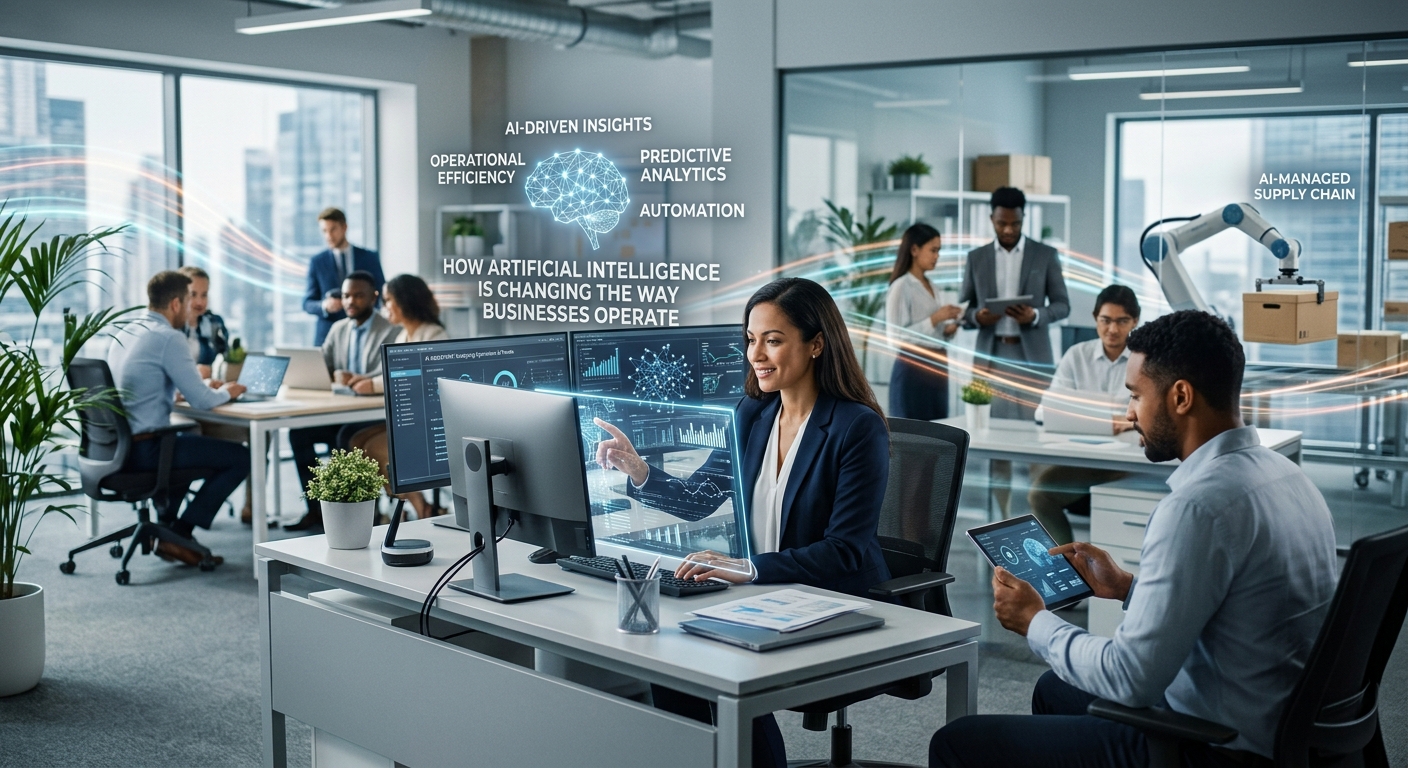
Artificial intelligence is rapidly moving from an experimental technology into a practical tool used in everyday business operations.
Once associated primarily with major technology companies and specialized research laboratories, AI is now being adopted by organizations across retail, finance, manufacturing, professional services, marketing, customer support and many other industries.
Businesses are using artificial intelligence to analyze information, automate repetitive tasks, support employees, communicate with customers and improve decision-making. Generative AI has expanded those possibilities further by making advanced technology accessible through relatively simple interfaces.
The transformation, however, is not happening equally across every organization.
Large corporations may have the financial and technical resources to build customized AI systems, while small and medium-sized businesses often depend on commercially available tools. Yet the fundamental objective is increasingly similar: companies want to accomplish more with the employees, information and resources they already have.
Research from the OECD has identified artificial intelligence as a technology with significant potential to support productivity and innovation. Successful adoption, however, depends on more than simply purchasing software. Digital infrastructure, employee skills, management capabilities, data access and financing can all determine whether an AI investment actually produces useful results.
The companies that gain the most from artificial intelligence may therefore be those that treat it as a business transformation rather than simply another technology purchase.
AI in Business Is About More Than Automation
Automation is often the first concept associated with artificial intelligence.
It is certainly an important part of the technology’s value, but the potential applications are much broader.
Traditional automation works particularly well when a process follows predictable rules. AI can extend those capabilities by analyzing information, recognizing patterns, generating content and helping employees work with large amounts of data.
Consider a retailer.
The company might use AI to analyze purchasing behavior, identify changes in product demand, organize inventory information and assist customer-service representatives.
A professional-services business could use the same underlying technology very differently.
Employees might use AI to summarize meetings, organize documents, search large collections of information or create first drafts of routine materials.
In both examples, the objective does not necessarily need to be replacing employees.
AI can instead reduce the amount of time workers spend on repetitive activities.
That can allow employees to focus on work requiring judgment, creativity, communication, relationship-building or specialized expertise.
Customer Service Is One of the Most Visible Changes
Customer support has become one of the clearest examples of practical AI adoption.
Traditional customer-service operations often require employees to repeatedly answer similar questions.
Customers may want to know when an order will arrive, how to reset a password, whether a product is available or how to schedule an appointment.
AI-powered systems can handle many of these routine interactions.
This can provide several potential advantages.
Businesses may be able to offer assistance outside traditional working hours, reduce response times and allow human agents to concentrate on more complicated customer problems.
However, customer-service automation also demonstrates why AI should not always operate independently.
A customer with an unusual billing dispute, sensitive complaint or complicated technical issue may quickly become frustrated if an automated system repeatedly fails to understand the problem.
For that reason, hybrid systems can often be more effective.
AI handles predictable requests while employees remain available for situations requiring judgment or empathy.
The goal should not necessarily be maximizing automation.
It should be using automation where it genuinely improves service.
AI Can Help Businesses Understand Their Data
Modern companies generate enormous amounts of information.
Sales systems record transactions. Websites collect traffic data. Marketing platforms measure advertising performance. Customer-service departments track interactions. Inventory systems monitor products, while accounting platforms generate financial records.
The challenge is turning that information into something useful.
Employees can manually analyze data, but the task becomes increasingly difficult as the amount of information grows.
Artificial intelligence can help organize and interpret those datasets.
A manager might use an AI system to identify products experiencing declining sales, highlight unusual changes in customer behavior or summarize patterns across thousands of customer reviews.
Businesses can also use AI to identify operational bottlenecks.
If one process consistently requires more time or produces more errors than others, technology may help managers recognize the problem earlier.
This can make AI a valuable decision-support tool.
Human Judgment Still Matters
Using artificial intelligence to analyze information is different from allowing artificial intelligence to make every decision.
AI systems can make mistakes.
Data can also be incomplete, outdated or biased.
A model analyzing sales information, for example, may correctly identify a decline but fail to understand an unusual external event that caused it.
Human managers can provide that context.
A useful model for many businesses is therefore AI-assisted decision-making rather than fully automated decision-making.
The technology can gather information, summarize possibilities and identify patterns.
Humans can then evaluate those outputs alongside experience, business objectives and other information the AI may not have.
This distinction becomes even more important when decisions involve employees, customers, finances or legal obligations.
Small Businesses Can Benefit From AI Too
Artificial intelligence is not limited to multinational corporations with enormous technology budgets.
Commercial AI tools have dramatically reduced the cost of experimenting with the technology.
Small and medium-sized enterprises can access capabilities that would previously have required specialized software development teams.
OECD research indicates that AI adoption among smaller companies remains lower than among large businesses. However, SMEs also have substantial opportunities to benefit from the technology.
A small company could use AI to draft marketing materials, summarize meetings, organize information, analyze customer feedback, assist with customer service or examine sales data.
Administrative work provides another opportunity.
Employees in smaller businesses frequently perform multiple roles.
A manager might simultaneously handle customers, marketing, invoices, scheduling and internal communications.
Saving even a few hours per week on repetitive administrative work could therefore create meaningful value.
The key is choosing the right task.
Businesses Should Start With Problems, Not AI Tools
One of the easiest mistakes companies can make is purchasing AI technology without identifying what problem it is supposed to solve.
The popularity of artificial intelligence can create pressure to adopt new tools simply because competitors are doing so.
That approach can lead to unnecessary costs and limited results.
A more practical strategy begins with the business process.
Managers should identify repetitive, expensive or time-consuming activities and determine whether technology could improve them.
For example, imagine a company whose employees spend several hours every week manually organizing customer inquiries.
Instead of launching a broad AI transformation, the company could test whether one system can categorize those inquiries automatically.
The organization can then measure the results.
Did employees save time?
Did accuracy improve?
Did customers receive faster responses?
If the answer is yes, the business has evidence supporting further investment.
If not, it can change its approach before committing additional resources.
AI Is Changing the Skills Employees Need
Artificial intelligence also affects the workforce.
As software becomes capable of handling more routine activities, employees may spend less time performing repetitive work and more time supervising systems, evaluating information and solving unusual problems.
This changes the skills businesses value.
Technical knowledge remains important, particularly as companies adopt more sophisticated digital tools.
But human capabilities may become equally valuable.
Analytical thinking, communication, adaptability, creativity and problem-solving can become more important when employees are responsible for evaluating AI-generated information.
The World Economic Forum’s Future of Jobs research identifies analytical thinking among the most important core skills for employers, while AI and big data are among the fastest-growing areas of skills demand.
The implication for businesses is straightforward: AI investment and employee development should happen together.
Purchasing powerful software does not automatically improve productivity.
Employees need to understand what the technology can do, how to use it effectively and when its outputs should not be trusted.
Training Can Determine Whether AI Investments Succeed
Imagine two companies purchasing the same AI platform.
The first provides employees with training, creates clear guidelines and identifies specific workflows where the technology should be used.
The second simply gives employees access to the software.
The first company is more likely to generate consistent benefits.
Employees need practical guidance.
They should understand how to provide useful instructions to AI systems, how to evaluate outputs and how to identify information that should never be entered into external tools.
Managers also need training.
Leadership teams must understand enough about AI to evaluate whether proposed projects are solving genuine business problems.
Without that understanding, organizations risk spending money on impressive demonstrations that never translate into operational value.
Artificial Intelligence Introduces New Risks
The potential benefits of AI are significant, but so are the risks.
Accuracy is one of the most obvious concerns.
Generative AI systems can produce information that sounds convincing while being factually incorrect.
That makes human verification essential in many situations.
The level of oversight should increase with the consequences of an error.
A mistake in an internal brainstorming document may have limited impact.
Incorrect information used for financial, legal or medical decisions can create much more serious consequences.
Privacy represents another major concern.
Employees may be tempted to enter customer information, internal documents or confidential business data into third-party AI platforms without understanding how that information is processed.
Companies therefore need clear data policies.
Cybersecurity must also be considered as organizations connect more systems and automate additional workflows.
Every new technology can create new vulnerabilities if it is implemented without appropriate controls.
A Practical Framework for Introducing AI
Businesses do not need to transform every department simultaneously.
A gradual approach can reduce both cost and risk.
The first step is identifying a repetitive task with measurable characteristics.
Managers should determine how much employee time the existing process requires and what problems frequently occur.
The company can then test one AI solution.
Results should be measured against the original process.
If the technology reduces costs, saves time or improves quality, the organization can consider expanding its use.
Human review should remain part of the process wherever mistakes could create meaningful consequences.
Only after a system demonstrates consistent value should the business consider applying the same approach elsewhere.
This creates a cycle of experimentation, measurement and expansion rather than attempting an expensive company-wide transformation immediately.
AI Could Redesign How Companies Organize Work
The biggest long-term impact of artificial intelligence may extend beyond individual tasks.
AI could gradually change how work itself is organized.
If employees spend less time searching for information, preparing routine documents or performing repetitive analysis, companies may restructure roles around higher-value activities.
Information may move more quickly between departments.
Managers may receive analysis faster.
Customer-service employees may spend more time solving difficult problems instead of answering predictable questions.
Marketing teams may devote more time to strategy while AI assists with repetitive production tasks.
These changes may seem small individually.
Across an entire organization, however, they can alter productivity and operating models substantially.
The Future of AI in Business Is Practical
Artificial intelligence is increasingly becoming ordinary business infrastructure rather than a futuristic concept.
The most important question is no longer whether AI can generate text, analyze information or automate tasks.
The more useful question is where those capabilities create measurable business value.
Companies that succeed with AI will not necessarily be those using the largest number of tools.
They are more likely to be organizations that understand their operations, identify appropriate applications and measure results carefully.
They will also need to invest in people.
Human judgment, communication and accountability remain critical even as technology becomes more capable.
AI can help employees analyze information faster and automate repetitive work, but businesses still need people to determine objectives, evaluate results and understand context.
The next phase of artificial intelligence adoption will therefore be less about experimenting with what AI can do and more about determining where it should be used.
For businesses of every size, the opportunity is substantial.
But capturing that opportunity requires a disciplined approach: start with a real problem, choose the appropriate technology, train employees, protect sensitive information, maintain human oversight and measure whether the system actually improves performance.
Artificial intelligence may provide the technology.
How businesses choose to use it will ultimately determine its value.