
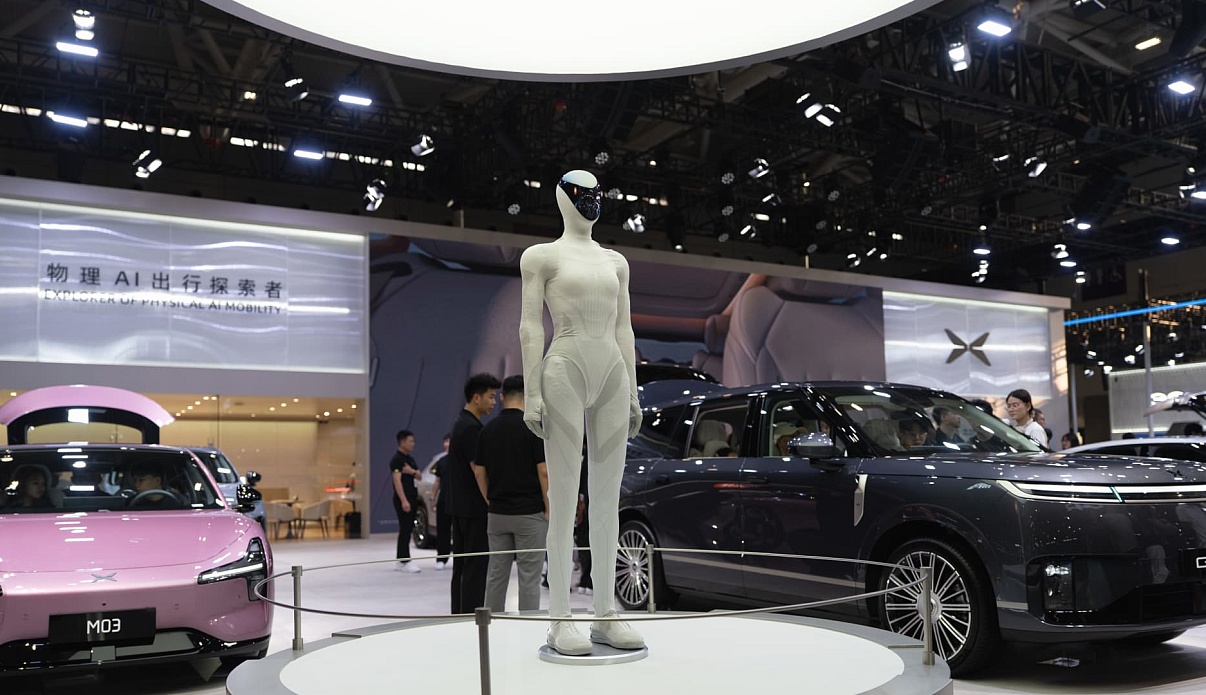
Chinese electric vehicle manufacturers are increasingly looking beyond cars and toward humanoid robots as slowing growth in the world’s largest automotive market puts pressure on sales, profitability and investor expectations.
Companies that spent years competing to dominate China’s electric vehicle revolution are now attempting to position themselves at the center of another emerging technology: embodied artificial intelligence.
Xpeng is among the most aggressive players in the shift. The electric vehicle manufacturer plans to begin mass production of humanoid robots by the end of 2026, initially deploying the machines within its own operations before expanding sales to external customers.
Other major Chinese automotive and technology companies, including Nio, Xiaomi, Li Auto, Geely and BYD, are also exploring robotics through internal development, investments or partnerships.
The trend comes as China’s EV industry enters a more difficult phase.
Domestic vehicle sales are experiencing their slowest growth since 2021, while intense competition has forced manufacturers to fight aggressively over pricing and market share.
For automakers, humanoid robotics offers both a new growth narrative and a potential way to reuse billions of dollars of investment already made in artificial intelligence, chips, motors, batteries, autonomous driving and advanced manufacturing.
The question is whether robots can eventually become a meaningful business — or whether they remain an expensive technological experiment.
China’s EV Slowdown Creates Pressure for New Growth
China’s electric vehicle industry expanded rapidly over the past several years, supported by technological improvements, government policies and strong consumer demand.
That growth attracted dozens of competitors.
As the market matured, however, competition intensified and profitability became increasingly difficult to maintain.
According to data from the China Association of Automobile Manufacturers, the average profit margin across China’s vehicle manufacturing sector fell to just 1.5% during the first half of 2026.
The pressure has also been visible in public markets.
Xpeng shares have declined more than 45% this year, while BYD’s stock has fallen more than 13% as the company experienced weaker sales.
For automakers accustomed to presenting investors with rapid expansion, a slowing core market creates an obvious challenge.
Humanoid robotics provides a potential alternative.
Instead of being valued purely as automobile manufacturers, companies such as Xpeng can increasingly present themselves as broader artificial intelligence and advanced manufacturing businesses.
More Chinese Automakers Are Entering Robotics
The movement extends well beyond Xpeng.
More than half of the nearly 20 global automakers currently involved in humanoid robotics development are Chinese companies.
Their strategies vary considerably.
Some manufacturers are building robots internally, while others are investing in specialized startups or supporting new companies through venture capital and incubation programs.
Nio’s venture arm, for example, has invested in humanoid robotics companies including LimX Dynamics and Acorn Robot.
Xiaomi, Li Auto and Geely have also established positions in the sector.
BYD is already using robotics within its operations, while Xiaomi has begun testing humanoid robots in factories after its relatively recent entry into electric vehicles.
The level of activity illustrates how closely China’s automotive industry increasingly overlaps with robotics and artificial intelligence.
Modern electric vehicles are already sophisticated robotic systems in many respects.
They use cameras, sensors, processors and AI software to understand their surroundings and respond to changing conditions.
Humanoid robots require many of the same technological foundations.
Why Building Robots Makes Sense for EV Companies
Jing Yang, a director at Fitch Ratings, has described the move toward robotics as a natural response to slower growth in the electric vehicle industry.
The strategic logic centers on technology reuse.
Electric vehicle manufacturers have spent enormous amounts of money developing electric motors, battery systems, artificial intelligence, sensors, autonomous driving software and advanced manufacturing capabilities.
Many of those technologies can potentially be adapted for robots.
That means an automaker entering humanoid robotics is not necessarily starting from zero.
If companies can share technology platforms across vehicles and robots, the economics become considerably more attractive.
Research and development spending can support multiple product categories.
Factories and supply chains can potentially be reused.
Software developed for autonomous vehicles can provide a foundation for robotic perception and decision-making.
Over the medium term, those efficiencies could potentially improve profitability.
Xpeng Raises $900 Million for Robotics Business
Xpeng’s robotics ambitions have attracted substantial financial backing.
The company recently secured $900 million for its robotics division, representing the largest single funding round in China’s embodied AI industry.
The transaction valued the robotics operation at more than $6.3 billion.
That figure is particularly striking because it brings the value of Xpeng’s robotics division close to the valuation of its established electric vehicle business.
The funding demonstrates the enormous investor enthusiasm surrounding embodied AI.
Unlike AI systems that operate primarily through computers and smartphones, embodied AI connects artificial intelligence to physical machines capable of interacting with the real world.
Humanoid robots are one of the most ambitious examples.
A sufficiently advanced humanoid could theoretically perform tasks across factories, warehouses, retail stores, homes and other environments designed around human movement.
That potential has attracted significant investment even though large-scale commercial adoption remains uncertain.
Xpeng Can Reuse Much of Its Existing Technology
One of Xpeng’s biggest advantages is the ability to transfer technology directly from cars into robots.
The company reportedly reuses approximately 85% of the motors, chips and smart-driving software developed for its vehicles in its humanoid robotics program.
That level of overlap could dramatically reduce development costs compared with building an entirely new technology platform.
Motors developed for electric vehicles can contribute to robotic movement.
Advanced chips can process information collected by cameras and sensors.
Artificial intelligence systems created to help vehicles navigate complex roads may provide foundations for robots attempting to understand physical environments.
There are limits to the comparison.
Driving a vehicle and controlling a humanoid body are fundamentally different problems.
Still, the shared technological infrastructure gives automotive companies an important starting point.
Factories Provide a Ready-Made Testing Ground
Chinese automakers also have another advantage: they already operate large physical environments where robots can be tested.
Xpeng plans to initially deploy its humanoid robots internally at company stores and factories.
That approach allows the manufacturer to evaluate its machines under real operating conditions before attempting to sell them widely to outside customers.
Factories can provide repetitive tasks where robotic performance is easier to measure.
Engineers can observe reliability, battery performance, movement, object manipulation and interaction with human employees.
Every deployment also generates additional data.
That data can then be used to improve the AI systems controlling the robots.
This creates a potentially powerful development cycle.
The company builds robots, deploys them in its own facilities, collects operational data, improves the software and then returns upgraded systems to the same environments.
Automakers with large manufacturing networks may therefore have a practical advantage over robotics startups without comparable testing infrastructure.
Mass Production Could Be Another Automotive Advantage
Building an impressive robot prototype is very different from manufacturing thousands of reliable units.
This is another area where automakers could have an advantage.
Car manufacturers already understand complex supply chains, quality control, large-scale assembly and product reliability.
Modern vehicles contain thousands of components that must work together safely for years.
Humanoid robots face similar manufacturing challenges.
They require motors, joints, sensors, batteries, processors and mechanical structures to operate reliably as integrated systems.
Xpeng plans to begin mass production of humanoid robots by the end of 2026.
The initial units are expected to be deployed internally, followed by a broader commercial launch in China and international markets next year.
If the company can successfully move from prototypes to mass production, it could provide an important test of whether automotive manufacturing expertise translates effectively into robotics.
The Biggest Question Is Who Will Buy the Robots
Despite the excitement surrounding humanoid robotics, analysts remain cautious about commercial demand.
Jefferies analyst Xiaoyi Lei has noted that companies entering the sector have yet to demonstrate significant confirmed external orders or provide clear revenue forecasts.
That distinction is important.
Deploying robots inside a company’s own factories proves that the technology can be tested in a controlled environment.
It does not necessarily prove that independent customers are willing to pay enough for the machines to create a profitable business.
The economics will depend on several factors.
Robots need to perform tasks reliably enough to justify their cost.
Maintenance expenses must remain manageable.
Businesses also need evidence that robots can generate meaningful productivity improvements compared with traditional automation or human workers.
Until those questions are answered, robotics revenue remains difficult to forecast.
Autonomous Driving Software Cannot Simply Be Copied
The overlap between electric vehicles and robots is substantial, but it should not be overstated.
Software represents one of the biggest challenges.
Autonomous driving algorithms are designed primarily around vehicles operating on roads.
Cars move in relatively predictable ways and generally interact with environments governed by lanes, traffic signals and transportation rules.
Humanoid robots face a dramatically broader range of possibilities.
They may need to walk across irregular surfaces, climb stairs, manipulate objects, open doors, recognize people and react safely to unpredictable physical situations.
Controlling hands and fingers alone presents engineering challenges that do not exist in automobile navigation.
Automakers will therefore need to adapt their AI systems considerably.
The companies that succeed may be those capable of transforming automotive intelligence into more general forms of physical AI.
Geely and Xpeng Could Be Well Positioned
Analysts believe some Chinese manufacturers may have stronger robotics prospects than others.
Geely and Xpeng have attracted particular attention because of their broader focus on physical AI strategies.
Their ability to integrate artificial intelligence with hardware, manufacturing and supply chains could provide advantages if humanoid robots eventually develop into a large commercial market.
Other companies are taking different approaches.
Nio is using venture investments to gain exposure to specialized robotics startups.
Xiaomi can potentially combine expertise from consumer electronics, electric vehicles and smart devices.
BYD can use robots internally across its enormous manufacturing operations.
There may ultimately be several successful strategies rather than a single model.
A ‘ChatGPT Moment’ for Robots Could Still Be Years Away
The humanoid robotics industry remains in its early commercial stages.
Even companies focused exclusively on robotics have experienced uncertainty.
Unitree, another prominent robotics company, saw volatile stock performance shortly after listing in Shanghai.
Its founder has cautioned that widespread commercial adoption could still take years.
A transformative breakthrough comparable to the “ChatGPT moment” that accelerated public interest in generative AI may even be a decade away.
That possibility highlights the difference between technological progress and commercial maturity.
Humanoid robots can produce impressive demonstrations today, but widespread deployment requires much higher standards of reliability, affordability and intelligence.
A robot operating around humans must consistently perform tasks without creating safety risks or requiring constant supervision.
Achieving that level of autonomy remains a significant technical challenge.
China’s Integrated Approach Could Accelerate Development
Chinese automakers nevertheless have several characteristics that could accelerate progress.
They control large manufacturing operations.
They have established supply chains.
They already produce advanced electric motors, batteries and electronics at scale.
They also generate large quantities of real-world data through vehicles, factories and increasingly robotic systems.
The ability to immediately place humanoid robots into stores and production facilities could give Chinese manufacturers a constant stream of information about how the machines perform outside laboratories.
That practical deployment could prove particularly valuable.
Artificial intelligence improves through data, and physical AI requires data about movement and interaction with real-world environments.
Companies capable of operating large fleets of robots could therefore improve their systems faster than competitors limited to small-scale testing.
Humanoid Robots Offer Opportunity — but Also Significant Risk
For China’s EV manufacturers, robotics represents an attractive diversification opportunity at a time when the automotive market is becoming increasingly difficult.
The technology overlap is real.
Motors, chips, batteries, AI software and manufacturing capabilities developed for electric vehicles can potentially be reused across robotic platforms.
Xpeng’s $900 million funding round demonstrates that investors are willing to assign substantial value to that possibility.
But the financial case remains unproven.
The industry still lacks large-scale external orders, predictable revenue streams and clear evidence that humanoid robots can be manufactured and operated economically across a wide variety of applications.
That makes the next several years critical.
If companies such as Xpeng and Geely can transform their automotive technology into commercially useful robots, China’s EV manufacturers could evolve into much broader physical AI businesses.
If external demand fails to materialize, however, robotics could become another expensive area of research at a time when automakers are already facing pressure on margins.
For now, Chinese EV companies are making a significant bet.
They spent the past decade teaching machines how to drive.
Their next challenge is considerably more ambitious: teaching them how to move, work and operate alongside humans in the physical world.