
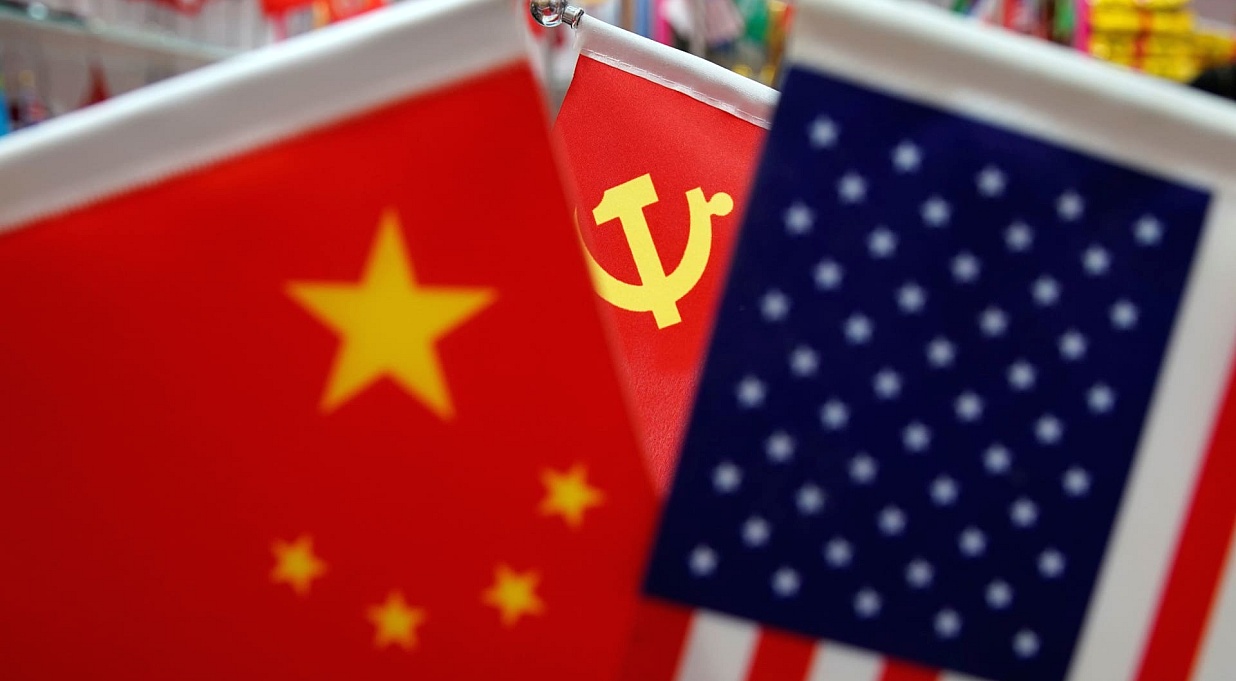
China has pushed back against calls from prominent U.S. artificial intelligence executives to slow the development of advanced AI systems, describing the warnings as “fear mongering” as competition between the world’s two largest economies increasingly centers on control of one of the most consequential technologies of the coming decades.
Chinese Foreign Ministry spokesperson Guo Jiakun criticized arguments that the AI industry should reduce the pace of development because of potential safety risks.
Guo warned that framing artificial intelligence primarily through confrontation and competition could undermine international cooperation and make global AI governance more difficult.
His comments come as several of the technology industry’s most influential figures — including Anthropic CEO Dario Amodei, OpenAI CEO Sam Altman and Elon Musk — have raised concerns about the speed at which increasingly powerful AI systems are being developed.
The debate reveals a growing contradiction at the center of the global AI race.
Governments and technology companies recognize that advanced artificial intelligence could create significant economic, scientific and military advantages.
At the same time, many of the people developing these systems are warning that moving too quickly could introduce serious risks.
Neither Washington nor Beijing appears willing to surrender technological leadership.
That creates a difficult question: how can countries manage the potential dangers of advanced AI without allowing competitors to gain a decisive strategic advantage?
China Calls AI Slowdown Warnings “Fear Mongering”
Guo’s response reflects Beijing’s concern that discussions about AI safety could become intertwined with geopolitical competition.
China has repeatedly emphasized the importance of international cooperation in emerging technologies while simultaneously investing heavily in its domestic AI industry.
From Beijing’s perspective, attempts to restrict development can potentially be interpreted not only as safety measures but also as efforts to preserve technological advantages.
Guo warned that confrontation could interfere with the creation of effective global governance mechanisms.
That concern is increasingly relevant as governments attempt to establish rules covering advanced AI systems.
Artificial intelligence does not operate within national borders.
Models can be developed in one country, deployed through cloud infrastructure in another and used by people throughout the world.
Creating international standards therefore requires some level of cooperation among governments that are also direct technological competitors.
U.S. AI Leaders Raise Concerns About Moving Too Quickly
Some of the strongest warnings about AI have come from executives building the technology themselves.
Anthropic CEO Dario Amodei has argued that racing ahead without sufficient safeguards could be reckless.
His concerns reflect a broader debate within the AI industry about whether increasingly capable models could eventually create risks that current institutions are not prepared to manage.
Sam Altman and Elon Musk have also publicly discussed the potential dangers associated with advanced artificial intelligence.
Their concerns differ in emphasis and proposed solutions, but all three have contributed to a growing conversation about whether AI capabilities are progressing faster than safety systems, regulation and society’s ability to adapt.
The issue becomes more complicated when geopolitical competition enters the discussion.
Amodei has also emphasized that the United States currently holds an advantage over authoritarian governments in advanced AI development.
That means slowing down is not simply a technical decision.
It could have strategic consequences.
AI Safety and National Security Are Becoming Connected
The central challenge is that AI safety and national security are increasingly difficult to separate.
If advanced artificial intelligence becomes as economically and strategically important as governments expect, leadership in the technology could influence productivity, scientific research, cybersecurity, military capabilities and intelligence operations.
A country that develops significantly more advanced AI systems than its competitors could gain substantial advantages.
That possibility creates pressure to move quickly.
But the faster companies and governments move, the more difficult it may become to test systems thoroughly before deployment.
The result is a classic strategic dilemma.
Everyone may benefit from careful development and effective safety standards.
But individual countries may fear that slowing down while competitors continue accelerating will leave them permanently behind.
China Is Also Concerned About AI Security
Despite Beijing’s criticism of warnings from U.S. technology executives, China is not dismissing AI-related risks.
Chinese Minister of State Security Chen Yixin has called for the rapid development of an AI security risk prevention and control system.
Chen described artificial intelligence as a central front in global technological competition and strategic rivalry among major powers.
He also emphasized the need for what Chinese officials characterize as healthy and orderly development.
This creates an important distinction in China’s position.
Beijing is criticizing what it views as excessive fear surrounding AI development while simultaneously calling for stronger domestic mechanisms to control security risks.
The two positions are not necessarily contradictory.
China appears to support continued rapid development while seeking stronger systems to monitor and manage the consequences.
That approach reflects the broader global challenge: governments want the benefits of AI without accepting uncontrolled risk.
Artificial Intelligence Has Become a Strategic Industry
The debate demonstrates how dramatically the role of artificial intelligence has changed.
Only a few years ago, AI was primarily discussed as a technology-sector story.
Today, governments increasingly treat it as strategic infrastructure.
Advanced AI could affect healthcare, defense, manufacturing, education, financial services, transportation, scientific research and energy.
It could also reshape labor markets by automating or transforming tasks currently performed by millions of workers.
The economic stakes are therefore enormous.
Countries that successfully develop and deploy AI could potentially experience substantial productivity gains.
Countries that fall behind could become dependent on foreign technology.
This helps explain why both the United States and China are reluctant to support policies that could weaken their competitive positions.
Trump Rejects Calls to Slow U.S. AI Development
President Donald Trump has rejected calls from AI executives to reduce the pace of development.
During a visit to Ireland, Trump emphasized the importance of maintaining American leadership over China.
“Whoever wins AI, wins,” Trump said.
The statement captures the administration’s strategic view of the technology.
From this perspective, artificial intelligence is not merely another commercial sector.
Leadership could influence the global balance of economic and technological power.
A unilateral U.S. slowdown could therefore create an opportunity for Chinese companies to close the gap or take the lead.
Trump’s position illustrates why even serious concerns raised by American technology executives may struggle to translate into policies designed to broadly reduce development speed.
A Global AI Slowdown Would Require Coordination
One of the biggest problems with slowing AI development is enforcement.
If a single company voluntarily reduces the pace of research, competitors can continue.
If one country introduces strict restrictions, companies in other jurisdictions may accelerate.
For a slowdown to have a meaningful global effect, major AI powers would likely need some form of coordinated agreement.
That would require trust.
Trust is precisely what is becoming more difficult as U.S.-China technological competition intensifies.
Both sides could worry that the other would publicly accept restrictions while privately continuing advanced research.
Verification would also be challenging.
Unlike nuclear facilities or large weapons systems, advanced AI research can take place inside data centers using computing infrastructure that also has legitimate commercial applications.
This makes international governance unusually complicated.
AI Stocks React to the Growing Debate
The discussion is also beginning to affect financial markets.
AI-related stocks came under pressure on Monday as investors considered the potential implications of slower development and increased regulation.
SoftBank fell approximately 10% in Japan.
The company is a major investor in OpenAI and has substantial exposure to the broader artificial intelligence investment cycle.
A sharp decline in an AI-linked company demonstrates how sensitive valuations have become to expectations surrounding the technology.
Investors have committed enormous amounts of capital based on the assumption that AI adoption will continue expanding rapidly.
If regulation slows deployment, the economics of those investments could change.
On the other hand, insufficient regulation could create different risks, including security failures, public backlash and potentially costly accidents.
The AI Investment Boom Depends on Continued Growth
Artificial intelligence has driven investment across multiple industries.
Technology companies are spending heavily on data centers.
Semiconductor manufacturers are developing increasingly powerful processors.
Utilities are planning infrastructure to support rapidly growing electricity demand.
Energy companies are considering new generation capacity.
Networking, cooling and construction businesses are benefiting from hyperscale data center expansion.
This means the debate over AI development has consequences far beyond software companies.
A significant slowdown could affect the entire infrastructure investment cycle.
Conversely, continued acceleration could require even greater capital spending.
Markets therefore have strong reasons to follow the political and regulatory debate closely.
China Wants a Larger Role in Global AI Development
China is also positioning itself as an AI partner for developing economies.
At the BRICS summit in New Delhi, Chinese President Xi Jinping announced plans for China to take a leading role in artificial intelligence collaboration and development among emerging nations.
The strategy could expand China’s technological influence internationally.
Many developing countries want access to advanced AI capabilities but may not have the capital or infrastructure necessary to build frontier models independently.
Chinese companies could provide models, cloud infrastructure, technical expertise and other AI services.
This would create economic opportunities for China while potentially increasing dependence on Chinese technology.
Chinese AI Models Are Gaining International Attention
Chinese AI models are also reportedly seeing greater adoption among Western companies as their capabilities improve.
This development matters because the global AI race is not determined solely by which country creates the most powerful model.
Cost matters.
Efficiency matters.
Accessibility matters.
Developer adoption matters.
A model that performs slightly below the frontier but costs substantially less to operate can still become commercially important.
If Chinese companies can produce competitive models at lower costs, they could gain international market share even if U.S. companies retain an advantage at the technological frontier.
That possibility adds urgency to Washington’s focus on maintaining leadership.
Open Models Could Complicate the Competition
The spread of AI technology also makes traditional technological containment difficult.
Models, research papers and software techniques can move across borders.
Open-source and open-weight AI systems can allow developers around the world to build applications without relying entirely on a single American or Chinese provider.
This diffusion could reduce the ability of any government to maintain permanent control over advanced capabilities.
At the same time, access to enormous computing resources remains concentrated.
Training frontier systems can require sophisticated semiconductors, massive data centers, large quantities of electricity and billions of dollars of capital.
Control over those resources may therefore become one of the most important strategic advantages in the AI race.
China Faces the Same Fundamental Safety Problem
Despite political disagreements, China and the United States ultimately face many of the same technical questions.
How should increasingly autonomous AI systems be controlled?
How can developers prevent models from being misused?
How should governments address cybersecurity risks?
How can companies evaluate systems before deployment?
What happens when AI-generated information is incorrect but appears convincing?
How should advanced systems be used in critical infrastructure or national security?
China’s call for an AI security risk prevention and control system shows that Beijing recognizes these concerns.
The disagreement is less about whether risk exists and more about how those risks should be framed and managed while technological competition continues.
Global AI Governance Faces a Difficult Future
Guo’s warning about confrontation highlights the central challenge facing international AI governance.
The countries most capable of developing advanced artificial intelligence are also strategic competitors.
They have strong incentives to cooperate on safety.
But they also have strong incentives to maintain or gain technological advantages.
Any international framework would need to balance those competing priorities.
Rules that are too weak may fail to address meaningful risks.
Rules that are too restrictive may be rejected by countries concerned about falling behind.
And rules perceived as favoring one country or group of companies may struggle to gain international legitimacy.
The AI Race Is Becoming a Geopolitical Race
The dispute between Chinese officials, American AI executives and the Trump administration illustrates how artificial intelligence has evolved from a technological competition into a geopolitical one.
Dario Amodei, Sam Altman and Elon Musk have raised concerns about the dangers of moving too quickly.
China has criticized some of that rhetoric as “fear mongering,” while simultaneously developing its own AI security controls.
Trump has rejected the idea of slowing American progress, arguing that leadership over China is strategically essential.
Xi Jinping, meanwhile, is seeking to expand China’s role in AI development across emerging economies.
These positions reveal a world in which virtually every major player wants safety — but no major power wants to lose the race.
That tension could define the next stage of artificial intelligence development.
Governments will need to decide how much regulation is necessary.
Companies will need to determine how quickly they can responsibly deploy increasingly powerful systems.
Investors will need to assess whether massive AI infrastructure spending can continue generating returns.
And international institutions will need to find ways to establish common standards among countries that increasingly view AI leadership as a matter of national power.
The fundamental question is no longer simply how powerful artificial intelligence can become.
It is whether the United States, China and the companies building the technology can develop effective safeguards without turning AI safety itself into another weapon in their strategic competition.
As Trump’s statement suggests, governments increasingly believe that whoever leads in AI could gain an extraordinary economic and geopolitical advantage.
That belief makes slowing down difficult — even when the people building the technology warn that moving too quickly may carry risks the world does not yet fully understand.