Prediction markets are entering what could become their most important period yet as the start of the NFL season collides with the intensifying U.S. midterm election campaign, creating a powerful combination of sports and political events capable of generating billions of dollars in trading activity.
After breaking into the mainstream during the 2024 presidential election, prediction markets have continued expanding into sports, monetary policy, economic events and other areas where traders can buy and sell contracts tied to real-world outcomes.
The 2025 NFL season helped establish sports as a major source of sustained activity for the industry. Now, with the 2026 football season underway and midterm election campaigns accelerating after Labor Day, platforms are preparing for another major test of whether prediction markets can become a permanent part of the financial and sports landscape.
Daily notional trading volume across the industry is now regularly reaching billions of dollars, with two major platforms dominating activity while a growing group of smaller exchanges competes for users and liquidity.
The next several months could determine which companies emerge as long-term winners — and whether regulators allow the industry’s rapid expansion to continue in its current form.
NFL Season Has Become a Critical Growth Engine
The NFL has emerged as one of the most important drivers of prediction-market activity.
The 2026 season began with significant attention as the New England Patriots faced the Seattle Seahawks in a rematch of the recent Super Bowl.
For prediction platforms, major NFL games provide an ideal environment for user engagement.
They are scheduled events with clear outcomes, enormous audiences and frequent opportunities for traders to express views about what will happen.
The NFL also offers a long calendar extending from the opening weeks of the season through the playoffs and Super Bowl.
That gives platforms months of recurring activity rather than a single event.
The importance of football was already visible during the 2025 season, when sports-related prediction trading helped extend the industry’s growth beyond the political cycle that initially brought many platforms into the mainstream.
Prediction Markets Became Mainstream During the 2024 Election
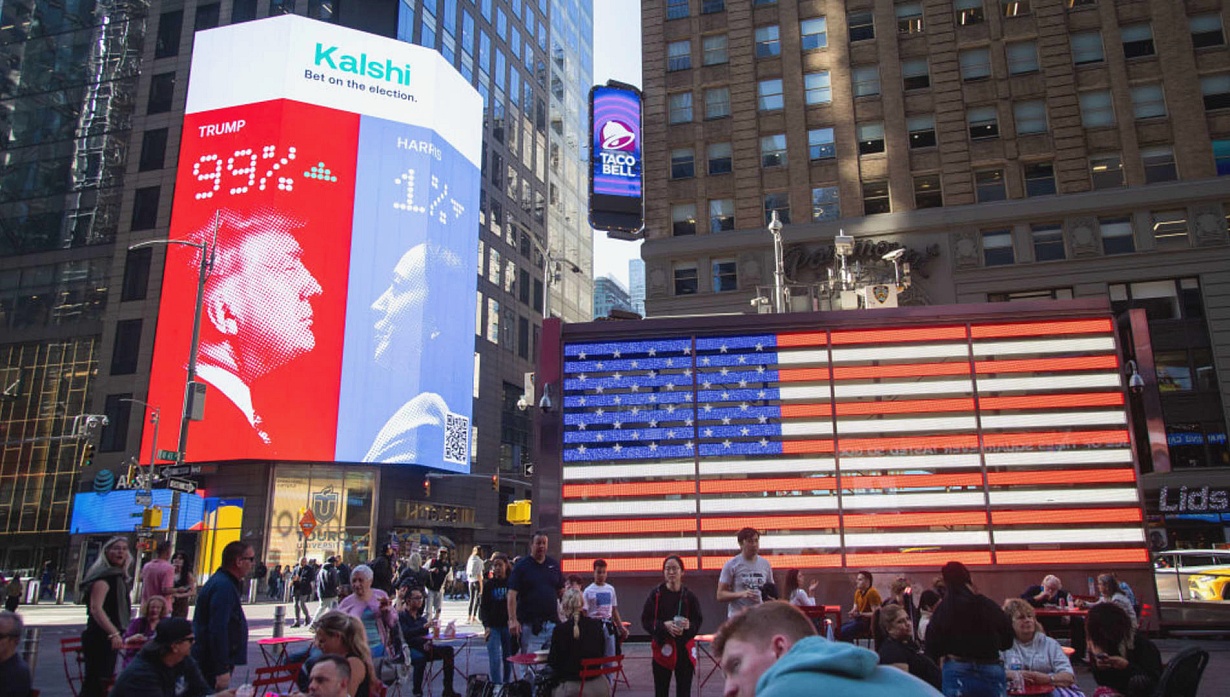
The 2024 U.S. presidential election represented a turning point.
Political prediction markets attracted widespread attention as users traded contracts based on election outcomes.
Unlike traditional opinion polls, prediction markets produce prices that continuously adjust as participants buy and sell positions.
A contract’s price can therefore be interpreted as the market’s collective assessment of the probability of a particular outcome, although market prices are not guarantees and can be influenced by liquidity, participant behavior and new information.
The presidential race demonstrated that a large audience was interested in following political events through market-based probabilities.
But a major question remained after the election: could these platforms retain users when there was no presidential contest?
Sports helped provide an answer.
The 2025 NFL Season Extended the Momentum
Instead of collapsing after the presidential election ended, prediction-market activity continued expanding.
The 2025 NFL season became an important bridge between political cycles.
Sports contracts provided traders with frequent events and helped platforms maintain engagement throughout the year.
That momentum has carried into 2026.
Daily notional trading volumes now regularly reach billions of dollars, according to the information provided.
The scale suggests prediction markets are evolving beyond a niche financial product.
However, the industry remains concentrated.
Two leading platforms account for much of the activity, while smaller exchanges are attempting to establish themselves before the market becomes more difficult to penetrate.
Midterm Elections Add a Second Major Catalyst
Sports are only one side of the industry’s fall opportunity.
Labor Day traditionally marks the beginning of the most intense phase of U.S. midterm election campaigns.
As candidates increase advertising, debates begin attracting more attention and polling becomes more frequent, prediction markets can offer contracts tied to political outcomes.
That creates a second major source of activity at almost exactly the same time as the NFL season.
The combination is particularly attractive for platforms because political and sports markets may appeal to different groups of users.
A football fan may initially join to trade NFL contracts and later explore economic or political markets.
Someone interested in elections may discover sports or Federal Reserve contracts.
This cross-category activity is one reason companies are investing heavily in new features and marketing.
Federal Reserve Decisions Are Expanding the Market
Prediction markets are also becoming increasingly relevant to financial events.
Federal Reserve interest-rate decisions have attracted significant trader interest.
Contracts can allow participants to express views on whether policymakers will raise, lower or maintain benchmark interest rates.
This expands prediction markets into territory traditionally dominated by financial derivatives, economist forecasts and futures markets.
Central bank decisions are particularly suited to event-based trading because they occur on scheduled dates and have clearly defined outcomes.
Economic data releases and monetary policy therefore give platforms another category capable of producing activity between major sporting and political events.
MLB Playoffs Add Another Major Sports Opportunity
Major League Baseball is also becoming part of the industry’s fall strategy.
With the MLB playoffs approaching, prediction-market companies are expanding partnerships and preparing products designed to capture increased sports interest.
The sports calendar creates overlapping opportunities.
Baseball moves into its postseason while football is gaining momentum.
That means users have multiple major events available throughout the week.
For smaller exchanges trying to establish liquidity, this period can be especially important.
A market without enough buyers and sellers can struggle to provide competitive pricing or allow traders to enter and exit positions efficiently.
Large sporting events can help concentrate enough activity to solve part of that problem.
New Platforms Face a Make-or-Break NFL Season
Seni Thomas, CEO of EDGE Markets, described the current football cycle as particularly important for newer companies.
“This NFL cycle is the real key, make or break,” Thomas said.
The comment reflects the competitive pressure facing smaller platforms.
Prediction markets benefit from network effects.
Users tend to prefer markets with greater liquidity because they can generally trade more easily.
Greater liquidity can attract additional traders, creating a cycle that strengthens already-established platforms.
New entrants therefore need to build meaningful activity quickly.
If they fail to establish themselves during a period when NFL, MLB and political interest are all elevated, competing later may become even more difficult.
Polymarket Turns to Major Sports Celebrities
Marketing competition has intensified alongside trading activity.
Polymarket launched an advertising campaign featuring major sports figures including LeBron James, Eli Manning and Derek Jeter.
The use of recognizable athletes demonstrates how aggressively prediction markets are attempting to move into mainstream sports culture.
Celebrity campaigns can introduce the concept to consumers who may never have used an event-contract platform.
Polymarket has also introduced a product designed to allow users to interact and trade collaboratively.
Social features could become an important differentiator as platforms compete not only to execute trades but also to create communities around events.
Kalshi Reports $2.3 Billion on College Football’s Opening Day
Kalshi recorded $2.3 billion in volume on the first day of college football, according to the information provided.
The figure demonstrates the enormous amount of activity that major sports events can generate.
The company has also introduced features allowing users to track their performance from the previous NFL season.
Historical performance data can encourage users to return by creating continuity between seasons.
Kalshi has also expanded partnerships ahead of the MLB playoffs, further demonstrating how sports are becoming central to prediction-market growth.
At the same time, the company is investing heavily in political products.
Technical Problems Show the Risks of Rapid Growth
The start of college football also exposed operational challenges.
Polymarket’s U.S. platform was offline for much of the day, affecting users during an important period of sports activity.
Refunds were issued to affected accounts.
Kalshi experienced a different problem when it mistakenly resolved a market involving a University of Michigan game before the correct outcome should have been finalized.
The company corrected the payout shortly afterward.
These incidents illustrate the technical complexity of running markets tied to live events.
A traditional financial exchange operates around securities or derivatives with established settlement mechanisms.
Sports event markets need reliable data feeds and precise rules for determining outcomes.
Mistakes can directly affect users’ money and therefore damage trust if they are not corrected quickly.
Reliability Will Become Increasingly Important
As prediction markets grow, operational reliability could become one of the industry’s most important competitive factors.
Users need confidence that platforms will remain available during major events.
They also need clear rules explaining how contracts are settled.
An outage during an ordinary period may be inconvenient.
An outage during a major NFL game or election night can be much more consequential because prices can move rapidly as new information becomes available.
Platforms therefore need technology capable of handling sudden surges in activity.
The larger the industry becomes, the less tolerant users may be of technical failures.
Regulatory Battles Remain a Major Risk
The largest uncertainty may not be technological.
Prediction-market companies continue facing legal challenges over sports-related event contracts.
The central question is whether these products should be regulated as federally supervised event contracts or treated as sports gambling subject to state laws.
The distinction has major implications.
Traditional sports betting is generally regulated at the state level in jurisdictions where it is permitted.
Prediction-market platforms operating through federally regulated structures argue that their contracts fall under the jurisdiction of the Commodity Futures Trading Commission.
Several states have challenged aspects of that interpretation.
The legal outcome could significantly influence how sports prediction markets operate across the United States.
Polymarket Emphasizes CFTC Compliance
Polymarket has reaffirmed its commitment to operating in compliance with the CFTC and providing what it describes as a secure and trusted product.
But the broader jurisdictional debate remains unresolved.
If courts or regulators impose significant restrictions on sports contracts, one of the industry’s largest growth categories could face disruption.
If federal oversight prevails more broadly, prediction platforms could gain greater clarity for nationwide expansion.
The regulatory environment is therefore likely to remain one of the most important factors affecting company valuations, product development and competition.
New Entrants Are Trying to Capture Market Share
The rapid growth has attracted new competitors.
Rothera, a joint venture between Susquehanna International Group and Robinhood, launched in May and has already experienced significant increases in trading volume as the sports calendar intensified.
The involvement of established financial companies demonstrates growing institutional interest in prediction markets.
Newer platforms are also using aggressive marketing strategies.
Novig launched an NFL advertising campaign featuring actress Sydney Sweeney.
The campaign represents one of the first examples of a smaller prediction exchange using a major celebrity endorsement to compete for attention.
ProphetX, which launched in June, is focusing on increasing liquidity in NFL markets and plans to introduce midterm election contracts.
Liquidity Could Determine Which Platforms Survive
For prediction exchanges, liquidity is critical.
A platform can offer hundreds of interesting contracts, but those markets have limited value if there are not enough participants willing to trade.
Low liquidity can create wider spreads between buying and selling prices.
It can also make it more difficult for traders to enter or exit larger positions.
This creates a competitive advantage for established platforms.
Smaller exchanges need to attract users, market makers or institutional participants capable of creating deeper markets.
The NFL season provides an opportunity because large numbers of users are interested in the same events simultaneously.
The midterm elections could provide another concentrated source of liquidity.
Election Products Are Becoming More Sophisticated
Kalshi is expanding its political offering ahead of the midterms.
The company introduced a dedicated midterm elections hub in July that provides extensive information on political races.
It is also developing tools and events for election night designed to allow users to follow changes in market odds in real time.
This illustrates how prediction platforms are evolving beyond simple trading interfaces.
They increasingly want to become destinations where users follow events, analyze information and discuss probabilities.
Election night could be particularly valuable because results arrive continuously.
As states and districts report votes, market probabilities can change rapidly.
That creates the type of real-time environment that prediction markets are designed to capture.
Fall 2026 Could Be a Defining Moment
The convergence of football, baseball, Federal Reserve decisions and midterm elections makes fall 2026 an unusually important period for prediction markets.
The industry has already moved far beyond its 2024 presidential-election breakthrough.
Sports helped maintain momentum in 2025.
Now daily notional volumes regularly reach billions of dollars, major platforms are investing heavily in marketing and product development, and new competitors are entering the market.
Kalshi’s reported $2.3 billion in volume on the first day of college football demonstrates the scale the sector can achieve.
Polymarket’s campaigns featuring LeBron James, Eli Manning and Derek Jeter show how aggressively companies are pursuing mainstream consumers.
New entrants such as Rothera, Novig and ProphetX are attempting to establish themselves while the market remains young enough for competitive positions to change.
But growth brings new challenges.
Technical failures during major sporting events can damage trust.
Liquidity remains difficult for smaller exchanges.
And legal disputes over whether sports event contracts fall under federal derivatives regulation or state gambling laws could reshape the industry.
The next several months will therefore test more than trading volume.
They will test whether prediction markets can operate reliably at scale, navigate regulatory uncertainty and convert users attracted by individual events into long-term customers.
If they succeed, 2026 could mark the year prediction markets evolve from an emerging financial phenomenon into a permanent category spanning sports, politics and economics.
If they fail, the combination of regulatory pressure, operational problems and intense competition could force consolidation.
Either way, the NFL season and U.S. midterm elections are giving the industry its biggest opportunity since the 2024 presidential race — and perhaps its most important test yet.