
Chinese humanoid robotics startup JoyIn has accused OpenAI of closely replicating elements of its artificial intelligence technology and presentation, escalating an increasingly contentious debate over model distillation, intellectual property and competition between U.S. and Chinese AI developers.
Guo Renjie, the leader of Suzhou-based JoyIn, made the allegations public in a Chinese-language letter released on September 10, 2026.
JoyIn, which is backed by Ant Group, claims that similarities between its work and more recent OpenAI projects extend beyond broad artificial intelligence concepts and into specific approaches involving model improvement, computing optimization and even the visual presentation of AI products.
The company is now preparing potential legal action over what it characterizes as “direct distillation” of its technology without meaningful modification.
The allegations have not been independently verified, and no court has established that OpenAI copied or improperly used JoyIn’s technology. OpenAI has not issued a public response to the accusations described in the original reporting.
The dispute nevertheless highlights a much larger problem facing the rapidly expanding AI industry: determining where legitimate technological competition ends and unauthorized replication begins.
JoyIn Alleges Similarities Between AI Frameworks
Guo’s accusations center partly on concepts appearing in AI systems developed by the two companies.
According to Guo, features involving “recursive self-improvement” and AI-directed optimization of computing resources appeared in both JoyIn’s “extraterrestrial visitor” framework and an OpenAI project referred to as “An Alien Mind.”
Guo argued that the timing was significant because OpenAI’s material appeared shortly after JoyIn presented its work in Silicon Valley.
The JoyIn leader also pointed to similarities in product presentation.
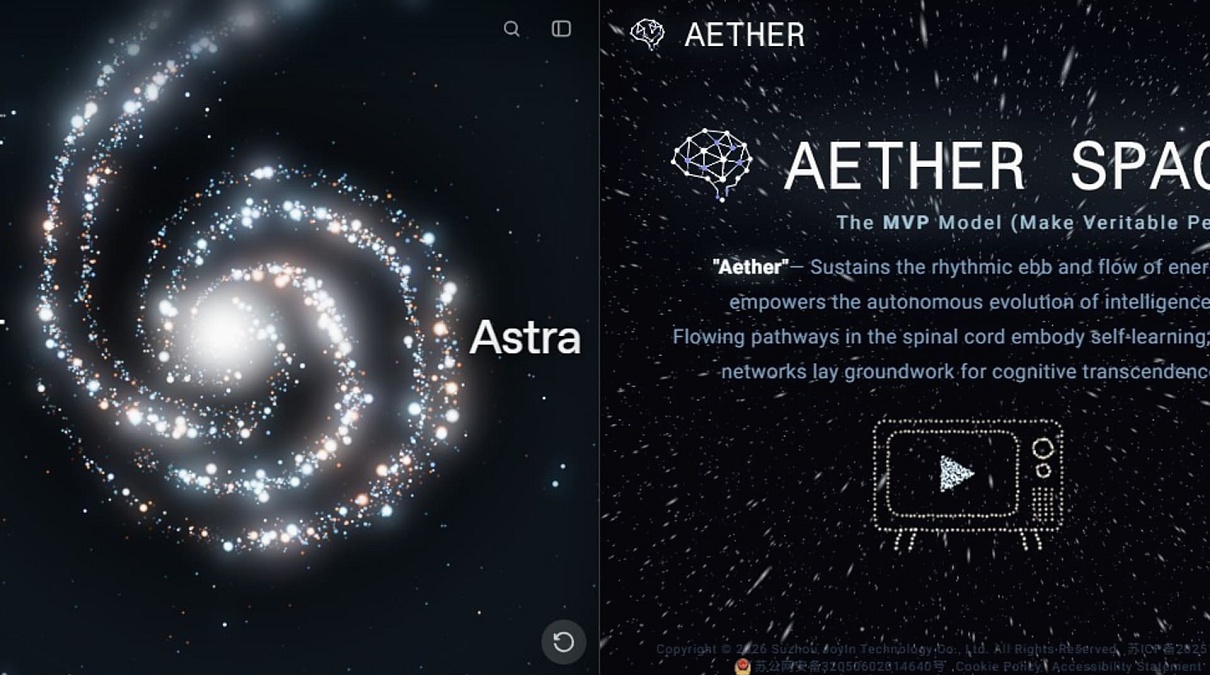
He said OpenAI’s GPT-6 Astra webpage resembles the earlier website used to present JoyIn’s Aether model.
Both reportedly use visual concepts inspired by outer space.
These observations form part of JoyIn’s argument, but visual or thematic similarities alone would not necessarily establish that underlying technology was copied.
Determining whether improper replication occurred would require considerably more evidence about the technical systems, training processes, code, data and access each company had to the other’s technology.
JoyIn Is Preparing for Possible Litigation
JoyIn says it has begun preparations to pursue legal action against OpenAI.
The startup’s most serious allegation involves what it describes as “direct distillation” of its technology without modifications.
Model distillation has become an increasingly important and controversial subject as AI systems become more powerful and expensive to train.
In general, distillation refers to a process in which a smaller or different model learns from the outputs or behavior of a more capable model.
The approach itself is not inherently improper.
Developers can use distillation internally to transfer capabilities from one model to another, potentially reducing computational requirements while preserving useful performance.
The controversy begins when one company is accused of using another company’s proprietary model outputs to train a competing system without authorization or in violation of contractual restrictions.
JoyIn’s allegations suggest that it believes something more significant than independent development occurred.
However, that claim remains disputed and unverified.
If litigation proceeds, the technical evidence behind the accusation would likely become central to the case.
Proving AI Copying Can Be Extremely Difficult
Artificial intelligence creates complicated intellectual-property questions because different companies can independently develop similar ideas.
Researchers often read the same academic papers, use similar architectures and work toward comparable technical objectives.
Two systems can therefore share characteristics without one having copied the other.
At the same time, AI models can potentially learn from outputs generated by competing systems, making it possible to reproduce some capabilities without obtaining the original model’s underlying code or parameters.
That creates a difficult evidentiary problem.
A company alleging improper distillation may need to demonstrate not only that two systems behave similarly but also that the accused developer had access to the original model and used that access in a prohibited way.
The legal questions can become even more complicated when companies operate in different countries with different intellectual-property regimes.
Model Distillation Is Becoming a Major Industry Issue
The JoyIn dispute is part of a much broader argument occurring throughout the artificial intelligence industry.
U.S. AI company Anthropic has also raised concerns about unauthorized use of its models by Chinese companies.
According to the information supplied in the original report, a recent statement from a U.S. cybersecurity agency identified six Chinese companies, including DeepSeek and Alibaba, in connection with allegations that models had been distilled from systems developed by Anthropic, Google and OpenAI.
Those claims illustrate the unusual position now facing leading AI developers.
Companies are competing aggressively to build better models while simultaneously trying to prevent competitors from extracting too much value from their systems.
The JoyIn accusations reverse a narrative that has often focused on American companies accusing Chinese developers of copying U.S. technology.
In this case, a Chinese startup is accusing a major American AI company of improperly replicating its work.
The Debate Goes Beyond Code
AI intellectual property does not involve only source code.
Modern AI systems contain several layers of potential competitive advantage.
Training data can matter.
Model architecture can matter.
Post-training techniques can matter.
Human feedback systems can matter.
The methods used to generate synthetic data can matter.
The way developers allocate computing resources can also affect performance.
In robotics, the complexity increases further because AI software needs to interact with physical hardware.
A humanoid robot needs to perceive its environment, understand tasks and translate decisions into physical movement.
It must respond to unexpected situations while operating safely and efficiently.
That means valuable intellectual property can exist throughout the entire system rather than in one easily identifiable piece of code.
JoyIn’s Aether Model Focuses on Robotic Perception
JoyIn’s Aether model is designed specifically around robot control.
Rather than relying primarily on text-based instructions, the system places significant emphasis on perception.
That approach reflects a fundamental difference between AI systems operating purely in digital environments and those controlling physical machines.
A chatbot can receive text and generate text.
A humanoid robot must interpret the physical world.
It may need to understand objects, distances, movement, pressure and changing environmental conditions.
It must then convert that understanding into actions.
According to JoyIn, Aether achieves a 90% success rate on first attempts at tasks.
The company also says the model can substantially reduce the amount of time required for training.
These performance claims are based on information attributed to JoyIn and should be evaluated within the context of the company’s own reporting.
Aether Reportedly Cuts Training Time by Two-Thirds
Zhu Mingxuan, who led development of Aether after leaving U.S.-based humanoid robotics company Figure, said the model reduces training time by approximately two-thirds.
Training efficiency is an important issue in humanoid robotics.
Robots need exposure to enormous amounts of information to perform a broad range of physical tasks reliably.
Training can require substantial computing resources as well as physical data collected from real-world environments.
Reducing that process could lower development costs and allow companies to improve robotic capabilities faster.
The potential economic implications are significant.
A humanoid robot that requires extensive manual programming for every new task has limited scalability.
A system capable of learning new behaviors efficiently could potentially be deployed across factories, warehouses and other environments with less customization.
That is one reason improvements in robotic AI are attracting substantial investment.
JoyIn Plans a Combination of Open and Proprietary Technology
JoyIn does not plan to keep every component of Aether closed.
According to the company, parts of the model’s code related to tactile functions will be open-sourced.
Other components will remain proprietary.
Technology associated with energy consumption, for example, will not be released publicly.
This hybrid strategy reflects a common challenge facing AI companies.
Open-sourcing technology can encourage developer adoption, accelerate research and help establish a system as an industry standard.
But companies also need to protect the technologies they believe provide their strongest competitive advantages.
For humanoid robots, energy efficiency could be especially valuable.
Physical robots are constrained by batteries and power consumption in ways that cloud-based AI systems are not.
A robot that performs sophisticated tasks but can operate only for a short period before recharging may have limited commercial usefulness.
Energy-management technology can therefore become a significant competitive differentiator.
Humanoid Robotics Is Becoming a U.S.-China Battleground
The dispute between JoyIn and OpenAI comes as humanoid robotics emerges as one of the most competitive areas of artificial intelligence.
Companies in both China and the United States are attempting to build robots capable of performing increasingly complex physical tasks.
The long-term vision is ambitious.
Developers hope humanoid machines could eventually work in factories, warehouses, stores, homes and other environments originally designed for humans.
The humanoid form offers a theoretical advantage because much of the physical world is already built around human dimensions and movement.
Doors, stairs, tools, shelves and workstations are designed for people.
A sufficiently capable humanoid robot could potentially operate in those environments without requiring businesses to redesign their infrastructure completely.
But achieving that level of versatility remains extremely difficult.
Human-Level Robotic Performance Remains a Major Challenge
AI models have made dramatic progress in language, images and software.
Physical intelligence presents a different challenge.
The real world is unpredictable.
Objects vary in shape, weight and texture.
Lighting changes.
People move unexpectedly.
A robot may encounter situations that were never included in its training data.
Even seemingly simple human activities can require complicated combinations of perception, balance and fine motor control.
Picking up an unfamiliar object without damaging it requires understanding its position, estimating how much force to apply and adjusting movement in real time.
Humans perform many of these tasks instinctively.
Robots do not.
This gap explains why companies are investing heavily in models capable of combining vision, touch and physical reasoning.
Distillation Could Become Even More Important in Robotics
Model distillation may become particularly valuable in humanoid robotics because robots cannot always rely on enormous cloud-based models for every decision.
A highly capable AI system may require substantial computing power.
Running such a model directly on a battery-powered robot can be difficult.
Smaller models capable of reproducing important behaviors from larger systems could make robotic deployment more practical.
That creates enormous commercial value around methods for transferring intelligence into more efficient models.
It also raises the stakes of intellectual-property disputes.
If one company spends significant resources developing a powerful robotic model and a competitor can cheaply reproduce much of its behavior through distillation, the economics of AI development could change dramatically.
Garry Tan Highlights a Broader Copyright Debate
Garry Tan, CEO of Y Combinator, has acknowledged concerns surrounding model distillation while also pointing to another controversial aspect of AI development: training data.
Tan emphasized that U.S. AI companies themselves train models using data that can be subject to copyright protections.
That observation highlights a broader inconsistency at the center of current AI debates.
AI developers want protection from competitors potentially using their model outputs without permission.
At the same time, many developers face questions from publishers, authors, artists and other copyright holders about the data used to train their own systems.
The legal system is still working through many of these questions.
The rules governing copyrighted training data, model outputs and distillation remain areas of intense debate.
The Potential Lawsuit Could Test Emerging AI Rules
If JoyIn ultimately files a lawsuit against OpenAI, the case could attract attention far beyond the two companies.
A legal dispute could force courts to consider what evidence is necessary to demonstrate improper model distillation.
It could also raise questions about whether model behavior itself can provide evidence of copying and how proprietary AI techniques should be protected.
International jurisdiction could add further complications because JoyIn is based in China while OpenAI is based in the United States.
The specific legal claims, jurisdiction and evidence would determine how any potential case proceeds.
At this stage, however, JoyIn has said it is preparing for litigation rather than presenting a final judicial finding.
The accusations should therefore remain clearly distinguished from established facts.
Competition Is Intensifying as AI Moves Into the Physical World
The JoyIn controversy reflects a larger transformation occurring in artificial intelligence.
The first phase of the recent AI boom was dominated by language models, chatbots and image-generation systems.
The next phase increasingly involves machines capable of interacting directly with the physical world.
Humanoid robots could represent one of the most significant applications of that transition.
But the enormous economic potential is creating equally intense competition.
Companies are racing to develop better models, acquire training data, recruit experienced researchers and improve hardware.
As those investments grow, disputes over who developed particular techniques — and whether competitors obtained them legitimately — are likely to become more common.
For JoyIn, the immediate issue is whether it can substantiate its claims that OpenAI directly distilled or replicated its technology.
For OpenAI, the allegations remain unanswered in the information currently available.
For the broader AI industry, however, the dispute highlights a problem that is unlikely to disappear.
Artificial intelligence advances partly because researchers build on previous discoveries.
At the same time, companies investing billions of dollars in proprietary models need incentives to protect their innovations.
Determining the boundary between inspiration, independent development, legitimate distillation and unauthorized copying may become one of the defining legal and technological challenges of the AI era.
As humanoid robotics moves closer to commercial deployment, that boundary could become even more important — and potentially far more valuable.