
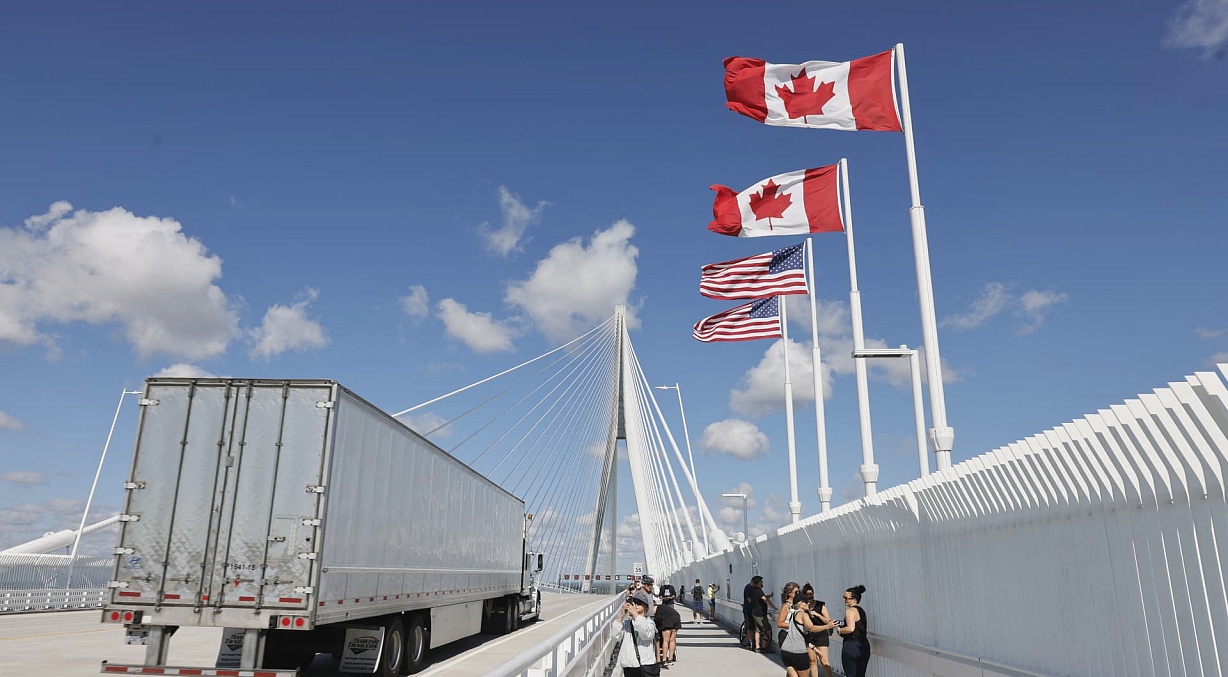
Canada has activated a broad package of retaliatory tariffs on U.S. products, escalating its trade conflict with the United States following the collapse of negotiations between the two countries last month.
The Canadian measures, which took effect Tuesday, cover approximately CA$27.6 billion worth of American goods and affect a wide range of industries, including dairy, agricultural machinery, paper products, household appliances and electronics.
Tariff rates range from 15% to as high as 50%, depending on the product. Duties on steel, aluminum and iron have doubled to 50%, while products including furniture, motorcycles, clothing and certain beauty products are also among those facing the highest tariffs.
Ottawa has described the measures as a “dollar-for-dollar” response to tariffs previously imposed by the United States on Canadian exports.
The latest escalation illustrates how quickly a trade dispute between two deeply integrated economies can spread across industries, affecting manufacturers, workers, consumers and businesses on both sides of the border.
Although the products directly affected represent only part of the enormous trade relationship between Canada and the United States, the consequences could be particularly significant for individual industries and small and medium-sized companies that depend heavily on cross-border supply chains.
Canada Responds to U.S. Tariffs
Canada’s latest measures were introduced in response to U.S. duties that took effect on August 22.
Those tariffs targeted Canadian exports including wine and hockey sticks and were set at 50%.
According to the information provided, the United States imposed the duties under a rarely used Depression-era law shortly after negotiations between Washington and Ottawa failed to produce a broader trade agreement.
Canadian officials have characterized their new tariffs as proportionate retaliation rather than an attempt to initiate a new dispute.
The Department of Finance said the measures are intended to defend Canadian workers, producers and manufacturers while improving their competitive position relative to affected U.S. imports.
The decision reflects a common strategy during trade disputes.
When one country places tariffs on another country’s exports, the affected government can respond by placing duties on products imported from the first country.
The objective is partly economic but also political: retaliatory tariffs can create pressure within the other country by increasing costs for industries and regions that depend on exports.
Tariffs Reach as High as 50%
The Canadian measures do not apply the same tariff to every product.
Instead, rates vary between 15% and 50%.
Steel, aluminum and iron are among the industries facing the strongest response, with tariffs doubling to 50%.
Furniture, motorcycles, apparel and certain beauty products are also subject to some of the highest rates included in the package.
Other affected categories include dairy products, agricultural machinery, paper, household appliances and electronics.
The range of goods demonstrates how trade conflicts can expand well beyond the industries that initially triggered a dispute.
A tariff targeting one Canadian industry can lead Ottawa to respond against completely different American products.
This strategy allows governments to select goods based on economic importance, availability of domestic alternatives and potential political impact.
Automotive Tariffs Remain in Place
Canada’s new tariffs are being added to existing trade restrictions rather than replacing them.
A 25% duty on certain U.S. automotive products remains in effect.
The automotive industry is particularly sensitive because manufacturing operations in Canada and the United States are deeply interconnected.
Vehicles can contain components produced on both sides of the border, and parts may cross the border during different stages of manufacturing.
Tariffs can therefore create complications that extend beyond the final vehicle.
Higher costs for imported parts can affect manufacturers, suppliers, dealerships and eventually consumers.
The political importance of automotive manufacturing also makes the sector especially sensitive during trade negotiations.
Factories support thousands of jobs directly and many more through parts suppliers, logistics providers and local businesses.
Negotiations Collapsed After Last-Minute Disagreements
The latest tariffs follow unsuccessful negotiations between the United States and Canada.
Both sides have accused the other of introducing unacceptable changes late in the process.
The failure to reach an agreement eliminated an opportunity to prevent the current escalation.
Trade negotiations between close economic partners can be complicated because agreements often cover numerous industries simultaneously.
A concession benefiting one sector may create political problems for another.
Agriculture, manufacturing, energy and transportation can each involve different priorities.
Once negotiations break down and tariffs take effect, reaching a compromise can become even more difficult because governments face pressure not to appear as though they are retreating.
Businesses, meanwhile, must operate without knowing whether tariffs will remain in place for months, years or only a short period.
That uncertainty itself can become an economic cost.
Trump Targets Bombardier
The dispute expanded beyond tariffs when President Donald Trump called for a boycott of Canadian aircraft manufacturer Bombardier.
Trump argued on social media that if Bombardier wanted access to the U.S. market, the company should manufacture its products inside the United States.
The comments brought the aerospace sector into the broader trade confrontation.
Bombardier responded by emphasizing that its economic relationship with the United States already extends beyond simply selling aircraft to American customers.
The company said it employs more than 1,000 people across over 20 U.S. states and relies on numerous American-made components.
Bombardier also reaffirmed its commitment to its U.S. employees, suppliers and business partnerships.
The response highlights one of the difficulties involved in modern trade disputes: multinational supply chains often make it difficult to classify a large company as purely foreign or domestic.
A Canadian manufacturer can simultaneously support significant employment and economic activity in the United States.
Kansas Lawmakers Defend Bombardier Jobs
Trump’s comments generated a response from political leaders in Kansas, where Bombardier maintains operations.
Senator Jerry Moran emphasized the company’s importance to local employment and the broader U.S. aerospace industry.
Senator Roger Marshall also said he would advocate for protecting more than 1,200 Bombardier-related jobs in Kansas.
The reaction demonstrates how national trade policy can create complicated political divisions within the United States.
A policy designed to pressure a foreign manufacturer may simultaneously affect American workers employed by that company.
The aerospace industry is particularly interconnected.
Aircraft manufacturers rely on extensive networks of suppliers producing engines, electronics, avionics, structural components and other specialized equipment.
As a result, actions affecting one company can have consequences across a much larger industrial network.
U.S.-Canada Trade Is Enormous
The economic relationship between Canada and the United States is among the most important bilateral trade relationships in the world.
According to data from the Office of the U.S. Trade Representative, the United States exported $333.6 billion worth of goods to Canada in 2025.
During the same year, the United States imported $381.9 billion in Canadian goods.
That means bilateral goods trade exceeded $700 billion.
The relationship covers an enormous range of industries, including energy, vehicles, heavy machinery, aircraft, pharmaceuticals, jewelry, furniture, apparel, food and beverages.
This scale helps explain why even tariffs targeted at a relatively limited number of products can attract significant attention.
The two economies are not merely trading finished products.
Companies frequently operate supply chains that cross the border.
A manufacturer in one country may depend on materials, equipment or components produced in the other.
Tariffs can therefore increase costs even for businesses that do not directly sell products to consumers across the border.
Small Businesses May Face Disproportionate Pressure
Economists and trade experts note that the affected products represent a relatively small portion of total U.S.-Canada trade.
That does not mean the economic consequences will be insignificant.
The impact of tariffs is rarely distributed evenly.
A multinational corporation operating in dozens of countries may be able to adjust its supply chain or absorb higher costs temporarily.
A smaller business that relies heavily on one supplier or one export market may have far fewer options.
Small and medium-sized enterprises can face higher import costs, lower demand from foreign customers and additional administrative expenses associated with customs and compliance.
Some companies may attempt to pass those costs to consumers through higher prices.
Others may accept lower profit margins to remain competitive.
Businesses with limited financial resources may have difficulty doing either for an extended period.
Consumers Can Eventually Feel the Effects
Tariffs are imposed on imported goods, but their economic effects can spread through the supply chain.
Importers must decide how to handle the additional cost.
Some may negotiate lower prices with suppliers.
Others may switch to alternative products.
Many eventually pass at least part of the expense to customers.
That means Canadian consumers could encounter higher prices for certain American goods affected by the new tariffs.
However, Ottawa’s strategy also appears designed to encourage consumers and businesses to purchase Canadian products or imports from countries not affected by the duties.
Whether that substitution is possible depends on the product.
For standardized goods with many suppliers, companies may be able to adjust relatively quickly.
For specialized industrial equipment or components, replacing an established supplier can be far more difficult.
Canada Announces Billions in Support
Recognizing the potential economic damage from the trade conflict, Ottawa has announced financial assistance for affected businesses and workers.
Last month, the Canadian government unveiled a CA$7.5 billion support package.
That assistance supplements a previous CA$25 billion fund created in response to U.S. tariff measures that began in April 2025.
Together, the programs demonstrate the scale of government intervention being used to cushion industries from the effects of the dispute.
Financial assistance can help businesses manage temporary disruptions, but it cannot eliminate all of the consequences of prolonged tariffs.
Companies still need predictable access to suppliers and customers.
Investment decisions become more difficult when future trade rules remain uncertain.
Trade Uncertainty Can Delay Business Investment
One of the less visible consequences of a tariff conflict is uncertainty.
Companies frequently make investment decisions years in advance.
A manufacturer considering a new factory needs to estimate material costs, demand, labor expenses and access to export markets.
If tariff policy changes repeatedly, those calculations become less reliable.
Some companies may postpone investment until trade rules become clearer.
Others may redesign supply chains to reduce exposure to cross-border risks.
Over time, this can change where companies manufacture products and where they purchase materials.
The longer the U.S.-Canada dispute continues, the greater the incentive for businesses to adapt permanently rather than wait for tariffs to disappear.
Retaliatory Tariffs Can Create Political Pressure
Canada’s “dollar-for-dollar” approach is also intended to create leverage.
Retaliatory tariffs can be selected to affect industries with political influence.
Exporters facing declining Canadian demand may pressure U.S. lawmakers and the administration to seek a negotiated settlement.
But retaliation also carries risks for Canada.
Tariffs increase costs for Canadian importers and can ultimately affect domestic consumers.
Governments therefore have to balance the desire to respond forcefully with the potential economic damage created at home.
This is why trade wars can become difficult to resolve.
Each side attempts to impose enough economic pressure to change the other’s behavior while minimizing the cost to its own economy.
The Next Step Depends on Whether Negotiations Resume
The activation of Canada’s CA$27.6 billion tariff package marks another escalation in a trade relationship already under considerable strain.
Tariffs of up to 50% now affect products ranging from metals and agricultural equipment to motorcycles, furniture and clothing.
Existing automotive duties remain in place.
At the same time, political rhetoric has expanded the dispute into aerospace, with Trump’s criticism of Bombardier prompting responses from the company and U.S. lawmakers concerned about American jobs.
Despite the confrontation, the economic relationship between Canada and the United States remains extraordinarily important to both countries.
Hundreds of billions of dollars in goods cross the border every year, supporting companies and workers across a wide range of industries.
That level of integration creates powerful incentives for an eventual agreement.
But it also means prolonged conflict can generate significant costs.
For now, Canadian businesses and consumers will begin adapting to the latest tariffs while Ottawa deploys billions of dollars in financial support.
American exporters will face additional barriers to one of their largest foreign markets.
The critical question is whether the latest round of retaliation creates enough pressure to bring both governments back to the negotiating table — or pushes one of the world’s largest bilateral trading relationships into an even deeper and more expensive confrontation.