
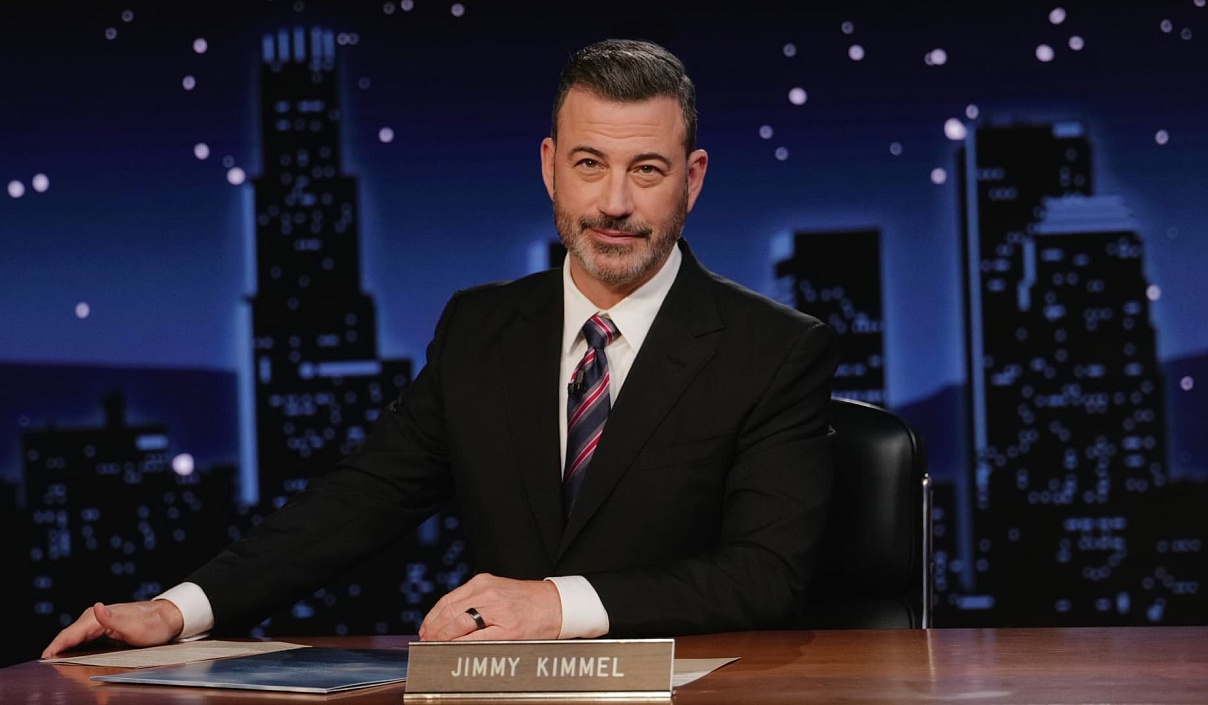
Jimmy Kimmel says an interview with Democratic Senate candidate James Talarico will not air nationally on ABC, with the late-night host instead planning to release the conversation on YouTube amid heightened scrutiny from the Federal Communications Commission over political content on television.
Kimmel explained the decision during his September 9 broadcast, saying concerns surrounding FCC rules and potential consequences for ABC affiliates influenced how the program would distribute the interview.
Rather than broadcasting the segment through the traditional television network, Kimmel said the interview would be made available online. According to his explanation, keeping it off national television until after the November elections avoids placing ABC affiliates in the middle of a regulatory dispute.
The decision comes as broadcasters face renewed questions about political interviews, equal-opportunity requirements and whether entertainment programs featuring candidates qualify for exemptions traditionally associated with legitimate news coverage.
The controversy also adds another chapter to the increasingly complicated relationship between ABC, the FCC and Kimmel, whose program has repeatedly found itself at the center of political and free-speech debates.
Kimmel Says FCC Pressure Influenced the Decision
During his September 9 program, Kimmel characterized the situation as a new challenge for television broadcasters operating under federal regulation.
He argued that ABC and its affiliated stations have faced increasing scrutiny from the FCC under the current presidential administration over editorial decisions and political content.
Kimmel’s concern centers partly on the position of local ABC affiliates.
While audiences may think of a national television program as being controlled entirely by a network, local stations operate under broadcast licenses and therefore have their own regulatory considerations.
Kimmel suggested that airing the Talarico interview nationally could expose those affiliates to additional pressure.
His solution was to separate the interview from the traditional broadcast.
Viewers will instead be able to watch the segment on YouTube, where the same broadcast licensing framework does not apply in the way it does to over-the-air television stations.
The distinction demonstrates how political programming can increasingly move between traditional television and digital platforms depending on regulatory and editorial considerations.
James Talarico Is Running in a Closely Watched Texas Senate Race
The political importance of Kimmel’s guest adds to the sensitivity surrounding the interview.
James Talarico, a Democratic Texas state representative, is competing in a closely followed Senate contest against Texas Attorney General Ken Paxton.
Paxton has received the endorsement of President Donald Trump.
According to recent public polling cited in the original reporting, Talarico holds a narrow advantage in the race.
As with any election polling, however, such numbers represent a snapshot of voter opinion rather than a prediction of the final result.
The contest has attracted additional attention because of Paxton’s long and controversial political history.
Paxton was impeached by the Texas House over allegations involving corruption and abuse of office. He was later acquitted by the Texas Senate.
The Senate race therefore carries significance beyond Texas, particularly because control of individual Senate seats can have national consequences.
That political context makes a national television interview with one candidate more sensitive under rules governing candidate appearances on broadcast stations.
The Dispute Centers Partly on Equal Airtime Rules
Federal broadcasting regulations include requirements intended to prevent licensed broadcasters from unfairly favoring one political candidate over another.
One of the best-known concepts is the equal-opportunities, commonly called equal-time, rule.
In general terms, when a legally qualified candidate is permitted to use a broadcast station, competing candidates can under certain circumstances become entitled to comparable opportunities.
But the system includes important exemptions.
Certain appearances in legitimate news programming, news interviews, documentaries and other qualifying formats may be treated differently.
That distinction has become particularly relevant as the boundaries between news, entertainment and political commentary have become increasingly blurred.
Late-night programs frequently interview politicians.
Daytime talk shows host presidential candidates.
Entertainment programs regularly discuss political issues.
The regulatory question is whether those appearances qualify under exemptions designed for bona fide news programming or whether they can create obligations involving opposing candidates.
FCC Questions About ‘Bona Fide’ News Programs Have Raised Concerns
Earlier in 2026, the FCC raised questions about whether some television talk shows should qualify as “bona fide” news programs for purposes of exemptions from candidate airtime requirements.
That issue has affected more than Kimmel’s program.
ABC’s “The View” has faced similar scrutiny.
The broader question is significant for television networks because talk shows often combine entertainment, commentary, celebrity interviews and political discussions.
A program does not necessarily fit neatly into a traditional category.
Late-night shows, for example, are primarily entertainment programs but can feature extensive political commentary and interviews with elected officials or candidates.
If regulators adopt a narrower interpretation of which programs qualify for exemptions, broadcasters may need to reconsider how they handle candidate appearances during election periods.
Kimmel’s decision to distribute the Talarico interview digitally illustrates one possible response.
YouTube Provides a Different Distribution Route
Moving the interview to YouTube allows Kimmel to reach a potentially large audience without airing the segment through ABC’s traditional broadcast network.
That difference matters because internet platforms and federally licensed broadcast stations operate under different regulatory structures.
The FCC’s authority over traditional broadcasting does not translate identically to online video platforms.
For Kimmel, digital distribution therefore offers a way to make the interview publicly available while reducing the regulatory concerns he says are facing ABC affiliates.
The strategy also highlights a major change in modern media.
Television programs are no longer dependent exclusively on television.
Segments can be distributed through YouTube, social media, streaming services and other digital platforms.
An interview withheld from national broadcast television does not necessarily disappear from public view.
In some cases, online distribution can even expand its reach beyond the program’s normal television audience.
Kimmel Has Interviewed Political Figures for Years
Political interviews are not new to “Jimmy Kimmel Live!”
Kimmel has spoken with numerous political figures over the years, including Donald Trump before his current presidency.
His program has also increasingly incorporated political commentary into its opening monologues and interviews.
That evolution has made Kimmel a prominent figure in broader arguments about entertainment, politics and the responsibilities of broadcasters.
Supporters of political commentary on late-night television often view it as an exercise of editorial and First Amendment rights.
Critics may argue that programs with large national audiences can influence political perceptions while operating primarily as entertainment rather than traditional journalism.
Those competing perspectives become more complicated when government regulations governing licensed broadcasters enter the discussion.
ABC and Kimmel Have Faced Previous Controversies
The latest dispute does not exist in isolation.
During the previous year, some ABC station owners declined to broadcast “Jimmy Kimmel Live!” following controversial remarks Kimmel made during a monologue.
ABC temporarily suspended the program, citing concerns surrounding the comments.
The episode intensified debate over how networks and local affiliates respond when political or controversial speech creates business, regulatory or public-relations risks.
Kimmel’s supporters viewed the situation partly through the lens of freedom of expression.
Others defended the ability of networks and station owners to make independent decisions about what they broadcast.
The current controversy involving the Talarico interview brings many of those questions back into focus.
This time, however, the debate also involves candidate airtime rules and FCC oversight.
ABC’s Relationship With the FCC Has Become Increasingly Contentious
Regulatory tensions involving ABC reportedly intensified earlier this year.
In April, the FCC initiated an early license renewal process involving ABC and focused partly on the company’s diversity and inclusion practices.
ABC subsequently filed its license renewal applications.
The dispute escalated further in August when ABC sued the FCC.
According to the network’s allegations, the commission had engaged in a retaliatory campaign that violated First Amendment protections.
Those are allegations made as part of an ongoing legal dispute and should not be treated as established findings.
The FCC’s position and the courts’ eventual interpretation of the dispute will be important in determining the broader legal implications.
Nevertheless, the existence of the lawsuit illustrates how seriously the network views its conflict with the regulator.
Broadcast Licenses Make Traditional Television Different
One reason the controversy is so complicated is that traditional broadcasters operate under a legal framework that differs from newspapers, websites and many online platforms.
Broadcast stations use public airwaves and require federal licenses.
The FCC therefore has regulatory authority over certain aspects of their operations.
At the same time, broadcasters have First Amendment protections and substantial editorial discretion.
Determining where legitimate regulation ends and unconstitutional government interference begins can produce difficult legal questions.
Election-related broadcasting rules add another layer.
Regulators have an interest in preventing licensed stations from unfairly manipulating candidate access.
Broadcasters, however, also need freedom to make editorial decisions about which political stories and interviews deserve coverage.
The tension between those principles is at the center of the current debate.
The First Amendment Question Could Have Broader Consequences
ABC’s accusations against the FCC raise issues extending well beyond one late-night television interview.
Government retaliation based on protected speech would raise serious constitutional concerns.
At the same time, federal agencies are permitted to enforce valid regulations within the authority granted to them by law.
The legal question therefore depends heavily on the specific actions involved, the FCC’s statutory authority and whether government decisions were based on legitimate regulatory considerations or impermissible retaliation.
Those questions ultimately require legal analysis and, potentially, judicial rulings.
Kimmel’s public comments represent his interpretation of the situation.
ABC’s lawsuit represents the network’s legal position.
Neither alone determines the final legal conclusion.
The Situation Highlights the Changing Nature of Political Media
The controversy also demonstrates how dramatically political communication has changed.
Decades ago, preventing an interview from airing on national television could substantially limit its audience.
That is no longer necessarily true.
Politicians and media organizations can communicate directly through YouTube, podcasts, livestreams and social networks.
Traditional broadcast regulation therefore exists alongside a digital media environment where political content can be distributed through completely different channels.
That creates an unusual situation.
The same interview can raise significant regulatory questions when aired through licensed television stations but face a very different legal framework when uploaded to an internet platform.
For broadcasters, digital distribution can become an alternative when traditional television creates legal or regulatory complications.
Political Campaigns May Pay Attention to What Happens Next
The situation could also matter to other candidates and television programs.
If networks become uncertain about whether entertainment and talk shows qualify for news exemptions, they may become more cautious about political interviews during election periods.
Programs could adjust guest schedules.
Networks might seek additional legal guidance.
Some interviews could migrate to digital platforms.
Candidates themselves could also respond by requesting comparable opportunities when opponents appear on television programs.
Much will depend on how the FCC interprets existing rules and how broadcasters respond.
The broader issue is unlikely to be limited to one candidate or one network.
Kimmel’s Decision Avoids One Immediate Conflict but Not the Larger Debate
Moving the James Talarico interview to YouTube provides Kimmel and ABC with a practical solution to the immediate problem.
The conversation can still reach viewers without being broadcast nationally through ABC affiliates before the November election.
But the decision does not resolve the larger questions.
Broadcasters still need clarity about how candidate appearances on entertainment programs should be treated.
Networks and regulators remain divided over the limits of federal authority.
ABC’s legal challenge against the FCC continues to raise First Amendment issues.
And politicians will continue appearing on programs that combine news, opinion and entertainment.
For viewers, the controversy is about much more than where one interview can be watched.
It reflects a larger transformation in the relationship between government regulation, traditional broadcasting and digital media.
Kimmel’s decision demonstrates the growing ability of television personalities to bypass traditional distribution when regulatory concerns arise.
But it also underscores the uncertainty facing broadcasters as political content becomes increasingly integrated into entertainment programming.
For now, the Talarico interview will move online rather than air nationally on ABC.
The more consequential question is whether this becomes an isolated workaround — or an example of how television networks and political programs increasingly respond to regulatory scrutiny in future election cycles.