Macy’s reported improving sales across its major retail businesses in the fiscal second quarter and raised its full-year financial outlook, providing fresh evidence that the department store operator’s multi-year turnaround strategy is beginning to gain traction.
Comparable sales increased 2.7% during the quarter across the company’s businesses, while the core Macy’s brand recorded a 1.1% increase. Performance was considerably stronger at the company’s higher-end Bloomingdale’s chain, where comparable sales jumped 11.3%, while beauty retailer Bluemercury posted growth of 6.2%.
The results are particularly important for Macy’s as the retailer approaches the end of a three-year turnaround effort aimed at improving its strongest locations, closing underperforming stores and creating a more compelling shopping experience.
CEO Tony Spring said the company is in a substantially healthier position than it was before the transformation began, arguing that Macy’s has become more relevant to customers while also developing a stronger proposition for investors.
The improvement was enough for management to raise its expectations for sales, comparable-store growth and earnings for the full fiscal year.
Still, investors remained cautious, with Macy’s shares declining modestly in morning trading despite the stronger results and improved guidance.
Macy’s Turnaround Begins to Show Results
Traditional department stores have faced years of pressure from e-commerce, specialty retailers, discount chains and changing consumer shopping habits.
Macy’s has not been immune.
The company’s response has centered on a broad transformation designed to concentrate resources on stores and brands with the greatest potential while improving the experience customers receive when they visit physical locations.
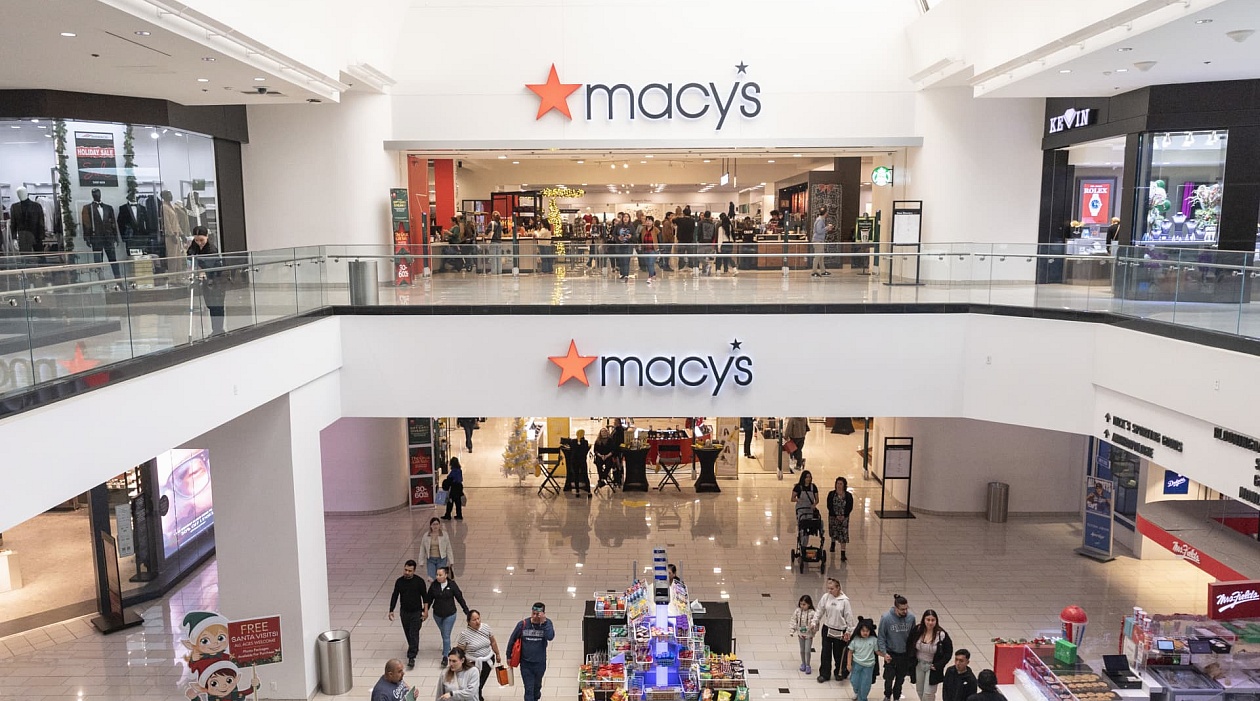
One of the most important elements has been Macy’s focus on what it calls reimagined stores.
Instead of spreading investment equally across the entire store network, the company has concentrated attention on locations that management believes can produce stronger long-term returns.
Those stores have received improved merchandise assortments, better product presentation and additional customer service.
The goal is to make shopping at Macy’s feel more deliberate and engaging rather than simply maintaining the traditional department store model.
The 1.1% comparable-sales increase at the Macy’s brand suggests the strategy is beginning to produce measurable results.
While that growth is modest compared with the performance of Bloomingdale’s, it represents progress for a business that has spent years trying to restore consistent customer traffic and sales growth.
Reimagined Stores Play a Central Role
Physical stores remain at the heart of Macy’s turnaround strategy.
The company has been working to improve how merchandise is selected, displayed and sold at key locations.
That includes providing stronger assortments tailored to customer demand and making products easier to discover.
Customer service is another priority.
Department stores historically differentiated themselves through service, product expertise and the ability to offer many categories under one roof.
As competition from online retailers increased, some of those advantages became less obvious.
Macy’s is attempting to restore them.
Better-trained employees, more attractive displays and improved merchandise availability can potentially give customers reasons to visit stores instead of simply shopping online.
The company is betting that the combination of physical retail and digital capabilities can create an experience that pure e-commerce competitors cannot easily replicate.
Bloomingdale’s Emerges as a Major Growth Engine
Bloomingdale’s delivered the strongest performance among Macy’s major retail brands.
Comparable sales increased 11.3% during the quarter, substantially outperforming the flagship Macy’s business.
The result reinforces the importance of higher-income consumers to the company’s broader strategy.
Bloomingdale’s occupies a more premium position in the market, offering designer apparel, accessories, beauty products and other higher-end merchandise.
Management believes one of the brand’s strengths is its ability to remain aspirational without becoming inaccessible.
That positioning allows Bloomingdale’s to compete for affluent consumers while still appealing to shoppers who may occasionally purchase premium products rather than exclusively buying luxury goods.
The company has also emphasized differentiation.
In a retail environment where consumers can compare products and prices instantly online, department stores need to provide more than simply inventory.
Unique merchandise, exclusive partnerships, customer service and distinctive store experiences can help prevent retailers from competing solely on price.
Bloomingdale’s quarterly performance suggests that strategy is resonating with shoppers.
Bluemercury Continues to Benefit From Beauty Demand
Bluemercury also produced solid growth, with comparable sales rising 6.2%.
Beauty has become an increasingly important category throughout the retail industry.
Unlike some apparel categories, beauty products often generate repeat purchases and can encourage customers to visit stores regularly.
Physical retail can also provide an advantage because consumers may want to test products, receive recommendations or consult beauty specialists before purchasing.
Bluemercury’s performance gives Macy’s another growth business outside its traditional department store operations.
The brand also provides exposure to consumers who may have different shopping habits from the typical Macy’s customer.
Together, Bloomingdale’s and Bluemercury are becoming increasingly important parts of the company’s portfolio as management attempts to build growth beyond the core Macy’s banner.
Macy’s Raises Its Full-Year Forecast
Improving second-quarter performance gave management enough confidence to increase its financial expectations for the full year.
Macy’s now expects net sales between $21.68 billion and $21.83 billion.
The company’s previous forecast called for sales between $21.5 billion and $21.75 billion.
Comparable sales growth is now expected to range between 1% and 1.5%.
Previously, management had projected growth between 0.5% and 1.2%.
The retailer also increased its earnings forecast.
Full-year earnings per share are now expected between $2.15 and $2.35, compared with the previous range of $2 to $2.20.
The revised earnings guidance includes an estimated benefit of approximately 5 cents per share related to tariff reimbursements.
The higher forecast signals that management believes the improvement seen during the quarter has enough momentum to continue through the remainder of the fiscal year.
Tariff Refunds Provide Additional Financial Flexibility
Macy’s has received approximately $116 million in tariff refunds.
Rather than using the entire amount to fund temporary discounts or provide an immediate boost to short-term results, the company plans to reinvest most of the money into its turnaround.
Approximately $96 million is expected to be directed toward initiatives designed to improve the customer experience and strengthen the business.
Spring has emphasized that the company wants to use the unexpected financial benefit to create lasting improvements.
The strategy reflects an important distinction.
A temporary price reduction might generate additional sales for a limited period, but investments in stores, service or merchandise could potentially produce benefits over several years.
Macy’s is therefore attempting to convert the tariff reimbursements into structural improvements rather than treating them simply as additional profit.
The company is also retaining part of the refunds to provide protection against uncertainties such as changes in fuel expenses.
Second-Quarter Profit Nearly Doubles
Macy’s also reported a significant improvement in profitability.
Net income reached $169 million, or 62 cents per share, during the fiscal second quarter.
That compares with $87 million, or 31 cents per share, during the same period a year earlier.
After excluding one-time items, adjusted earnings were 40 cents per share.
Sales totaled approximately $4.87 billion, slightly above the $4.81 billion reported in the prior-year period.
The improvement in net income was considerably stronger than the increase in revenue, suggesting that factors beyond simple sales growth contributed to better profitability.
For investors, that can be important.
Retailers can generate higher earnings not only by increasing sales but also through improved inventory management, stronger margins, cost discipline and more productive store operations.
The challenge for Macy’s will be demonstrating that those improvements can be sustained.
Credit Business Remains Stable
Credit card revenue also improved during the quarter.
The company reported a 2% increase in the category, supported by what management described as a healthy credit portfolio and stable net losses.
Department store credit programs can be financially important because they generate additional revenue while encouraging customer loyalty.
However, they can also provide useful information about consumer financial health.
A sharp deterioration in credit performance can indicate that customers are becoming more financially stressed.
For now, Macy’s said its portfolio remains healthy.
That is particularly relevant given the uneven financial conditions facing different groups of U.S. consumers.
Macy’s Sees a Divided Consumer Environment
Spring acknowledged that spending behavior continues to vary significantly depending on household income.
Higher-income consumers with substantial discretionary income remain willing to spend on fashion and other nonessential categories.
These customers can support businesses such as Bloomingdale’s and premium categories within Macy’s.
Lower-income consumers are behaving differently.
Households facing tighter budgets are increasingly focused on value and off-price products.
That creates both a challenge and an opportunity for Macy’s.
The retailer serves a broad range of customers, meaning it must appeal simultaneously to consumers willing to pay for premium products and shoppers who are highly sensitive to price.
Getting that balance wrong could weaken the brand.
Too much discounting can damage perceptions and reduce margins, while moving too far upscale could alienate Macy’s traditional middle-income customers.
Management believes its portfolio gives it the flexibility to serve both groups.
Why Shares Still Fell
Despite the stronger quarter and improved full-year guidance, Macy’s shares moved modestly lower during morning trading.
The reaction highlights an important reality of financial markets: strong results do not automatically lead to a higher stock price.
Investors compare reported performance not only with the previous year but also with expectations already reflected in the share price.
They may also remain cautious about the broader challenges facing department stores.
Macy’s still operates in an intensely competitive environment.
Online retailers, specialty stores, luxury brands, off-price chains and direct-to-consumer businesses are all competing for the same household spending.
The company must therefore prove that its recent improvement represents the beginning of sustainable growth rather than a temporary rebound.
The Three-Year Turnaround Approaches a Critical Stage
Macy’s is now approaching the conclusion of its three-year turnaround plan.
That makes the coming quarters particularly important.
Closing underperforming locations and investing in stronger stores can improve productivity, but investors will ultimately want evidence that the strategy can produce sustainable sales and earnings growth after the restructuring phase ends.
Bloomingdale’s 11.3% comparable-sales increase provides a particularly encouraging signal.
Bluemercury’s 6.2% growth adds another source of momentum.
The more difficult task may be restoring consistent growth across the much larger Macy’s brand.
The 1.1% increase recorded during the quarter is progress, but management will need to build on it.
Macy’s Faces Its Next Test
The second-quarter results provide evidence that Macy’s transformation is gaining momentum.
Comparable sales increased across its major brands, profitability improved and management raised its full-year outlook.
The company is also choosing to reinvest most of its $116 million in tariff reimbursements into the business, reinforcing its focus on longer-term improvements rather than temporary financial benefits.
Still, the turnaround is not complete.
Macy’s operates in a retail industry undergoing significant structural change, and consumer spending remains divided across income groups.
The company must continue improving its stores while remaining competitive online, maintaining attractive merchandise and controlling costs.
Bloomingdale’s and Bluemercury demonstrate that growth is possible within the portfolio.
Now the challenge is proving that the core Macy’s business can produce similarly durable improvements.
If the company can sustain comparable-sales growth, strengthen profitability and continue improving its most productive stores, the turnaround could mark the beginning of a more stable period for one of America’s most recognizable department store companies.
For investors, the next several quarters will help determine whether Macy’s has simply improved from a difficult starting point — or whether it has successfully built a retail model capable of generating lasting growth.